 Nathanael von Schlichtegroll, 1817, "Talhofer, ein Beytrag ..." - Bayerischen Staatsbibliothek München Nathanael von Schlichtegroll, 1817, "Talhofer, ein Beytrag ..." - Bayerischen Staatsbibliothek München |
 |
 |
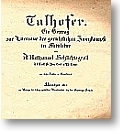
München, Verl. der Lithogr. 240 Kunstanst., 1817. - Although not a fecthbüch entitled "Talhofer, ein Beytrag zur Literatur der gerichtlichen Zweykämpfe im Mittelalter", Dr. Nathanael von Schlichtegroll authored this book entitled "A Contribution to the Works on the lawful Duels of the Middle Ages", where copies of drawings from a manuscript in the library at Gotha called "The Laws of Lawful Duel". These drawings detail the minutest details including one plate depicting two knights within a lists, about to engage in a duel on foot.
- released November 12, 2010- Click on the BSB logo to view an online presentation of the manuscript on the Münchener Digitalisierungszentrum website.
|
|
 Col. Thomas Stephens, 1843, "Broad and Small Sword Exercises" - PDF file (190MB) courtesy of M. Mercier, NSG Col. Thomas Stephens, 1843, "Broad and Small Sword Exercises" - PDF file (190MB) courtesy of M. Mercier, NSG |
 |
 |
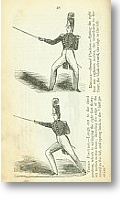
Dedicated to the Military of the United States, 1843. - Col. Stevens having improved and perfected the techniques of the sword, through observation, research and practice of the use of every "species" of modern weapons employed in the various schools of European military service. His desire was to create a uniform system of exercises for the American military personnel as well as any American citizen. The techniques described include fencing on foot and mounted on horseback, and a portion of the manuscript describes fighting using a carbine and pistol on horseback. His instructions touches upon the sense of time which may have been sourced from the works of George Silver although, specific sources of the details described in this manuscript are not revealed. A chapter devoted to "post practice" which describe a number of pells designed specifically to train fencing wtih sabre on horseback for "recruits". Beautifully illustrated, a worthwhile read and examination by any sword ethusiast, in particular, the interesting testimonials located at the end of the manuscript.
- released November 9, 2006
 | <== click icon to log into the library to access the manuscript
entitled Broad and Small Sword Exercises |
|
|
| Richard F. Burton, 1876, "A New System of Sword Exercise for Infantry" - Google Books |
 |
|
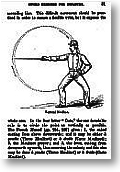
London: William Clowes and Sons, 13 Charing Cross. 1876. - The book is dedicated to His Royal Highness Field-Marshal the Duke of Cambridge. The book is well illustrated, and includes an illustration of a pell (the target), a series of guard positions armed with sabre, and interesting representations of the moulinet exercises with sabre, borrowed from a French publication "Maneul" and makes reference to the German system of the angles of cuts depicted in an illustration.
- released June 6, 2009 |
|
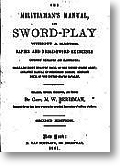
| Capt. M. W. Berriman, 1861, "The Militiaman's Manual and Sword-Play Without a Master..." - Google Books |
 |
|
New York. D.Van Nostrand, 192 Broadway. - The entire title for this work is "The Militiaman's Manual and Sword-Play Without a Master. Rapier and Broad-Sword Exercises Copiously Explained and Illustrated; Small-Arm Light Infantry Drill of the United States Army; Infantry Manual of Percussion Musket; Company Drill of the United States Cavalry". Capt. Berriman was very much in favour of an American standing army, despite some of the Republican's policies being considered, and a promoter of regular companies and in fact, encouraged them. The book does not reveal the source of the drills and exercises for the rapier and broadsword.
- released June 6, 2009 |
|
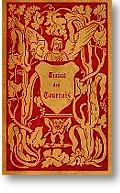
 Olivier de la Marche, et al, 1878, "Traicté de la Forme et Devis comme on Faict les Tournois" - courtesy of D. M. Cvet Olivier de la Marche, et al, 1878, "Traicté de la Forme et Devis comme on Faict les Tournois" - courtesy of D. M. Cvet |
 |

 |
Paris. A. Barraud, Libraire-Éditeur. 23, rue de Seine, 23. 1878. - The original treatise entitled "Traicté de la Forme de Devis d'un Tournoi by René d'Anjou of ca. 1460 which describes rules and execution of a tournament had been republished in 1878 in Paris by A. Barraud, Libraire-Editeur. It includes beautiful coloured illustrations, numbering 16 plates including 9 double plates depicting the preparations necessary for holding a tournament, a procession, examination of the arms and armour of the combatants and images of the tournament mêlée.
- released December 6, 2008
| <== click icon to log into the library to access the manuscript
entitled Traicté... les Tournois |
|
|
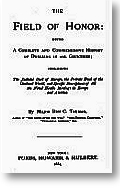
| Major Ben C. Truman, 1884, "The Field of Honor..." - PDF file (82MB) courtesy of S. Zimmerman, Academia della Spada |
 |

|
New York: Fords, Howard & Hulbert, 1884. - Entitled "The Field of Honor - Being a Complete & Comprehensive History of Dueling in All Countries", Truman begins with a discussion on the history of dueling, citing early examples including David and Goliath. According to Truman, the general practice of dueling for settling affairs of honor may have commenced in the year 1527, at the breaking up of a treaty between Emperor Charles V and King Francis I. He goes on to describing the situation of the duels occurring in the United States in the 1850's. The book covers dueling in France, England, Ireland and Scotland, Germany and America. There is a chapter entirely devoted to the same for Indians (as they are referred to in the book), Mexicans and the Japanese. He also discussed various modes of fighting such as dueling in the dark, and then reviews a number of noted European and North American duels.
- released October 28, 2005
| <== click icon to log into the library to access the manuscript
entitled The Field of Honor... |
|
|
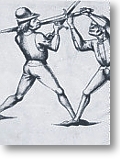
 Hergsell, Gustav, 1887, "Talhoffers Fechtbuch aus dem jahre 1467" - Universitätsbibliothek Augsburg Hergsell, Gustav, 1887, "Talhoffers Fechtbuch aus dem jahre 1467" - Universitätsbibliothek Augsburg |
 |
|
Prague, J.G.Calve & Unversitats-Buchhandlung , 1887. - A 19th-century Viennese fencing master, Gustav Hergsell edited, translated, and self-published the manuscript initially in 1887 followed by later re-publications in 1889 and 1901. His transcriptions and translation of the original treatise was not with vocal criticism. Hergsell transcribed only portions into modern German, leaving the rest as it were and really didn't regard it as being problematic.
- restricted access to AEMMA internally only
(December 08, 2001)- Click on the AEMMA arms to gain access to this restricted material (AEMMA students only)
|
|
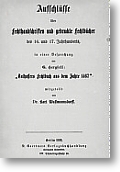
| Wassmannsdorff, Dr. Karl, 1888, "Aufschlsse ber Fechthandschriften...G.Hergsell" - Universitätsbibliothek Augsburg |
 |
|
Gaertners Berlagsbuchhandlung. Berlin, 1888. - A 19th-century fencing historian Dr. Karl Wassmannsdorff had found so much wrong with Hergsell's publication that he devoted an entire book to Hergsell's philosophical misdeeds. The treatise is entitled "Aufschlsse ber Fechthandschriften und gedrudkte Fechtbücher...G.Hergsell".
- restricted access to AEMMA internally only
(December 08, 2001)- Click on the AEMMA arms to gain access to this restricted material (AEMMA students only)
|
|
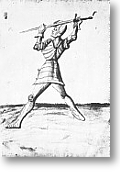
| Hergsell, Gustav, 1889, "Talhoffers Fechtbuch aus dem Jahre 1443" - Universitätsbibliothek Augsburg |
 |
 |
Prague, Selbstverlag, 1889. Gothaer Codex- A 19th-century Viennese fencing master, Gustav Hergsell edited and translated Talhoffer's 1443 fechtbuch in 1889. This and his other transcriptions and translation of the original treatise was not with vocal criticism. Hergsell's book also provides an indication of his position with respect to duels that tried to discourage "first blood" duels preferring instead the principles of dueling was until one of the participants was incapacitated.
- restricted access to AEMMA internally only
(December 08, 2001)- Click on the AEMMA arms to gain access to this restricted material (AEMMA students only)
- Click on the icon Escrime Ancienne for another online presentation of Livre D'Escrime de Talhoffer (Codex de Gotha) De L'an 1443.
|
|
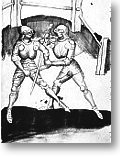
| Hergsell, Gustav, 1889, "Talhoffers Fechtbuch aus dem jahre 1459" - Universitätsbibliothek Augsburg |
 |
|
Prague, Selbstverlag, 1889. Ambraser Codex- A 19th-century Viennese fencing master, Gustav Hergsell edited and translated Talhoffer's 1459 fechtbuch in 1889. This and his other transcriptions and translation of the original treatise was not with vocal criticism.
- restricted access to AEMMA internally only
(December 11, 2001)- Click on the AEMMA arms to gain access to this restricted material (AEMMA students only)
|
|
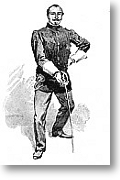
 Alfred Hutton, 1889, "Cold Steel, A Practical Treatise on the Sabre" - courtesy of Alfred Hutton, 1889, "Cold Steel, A Practical Treatise on the Sabre" - courtesy of
|
 |
|
London: Willam Clowes & Sons, Limited, 13, Charing Cross, 1889. - Hutton's "Cold Steel: A Practical Treatise on the Sabre" is based on the old English backsword play of the 18th century and is combined with the method of the "then" modern Italian school. This manuscript also includes other weapons including the short sword-bayonet, the constable's truncheon, and knife techniques (based on Marozzo's earlier works). With respect to the sabre, discussion surrounds the guards, moulinet, cuts, points, timing and distance, all aspects of swordplay regardless of whether longsword or sabre.
- released October 29, 1999- Click on the animated book image to gain access to the library's presentation pages on Hutton's book (pdf file, 11.45MB)
| <== click icon to log into the library to access the manuscript
entitled Cold Steel, A Practical Treatise on the Sabre |
|
|
| Alfred Hutton, 1892, "Old Sword-Play" - courtesy of |
 |
|
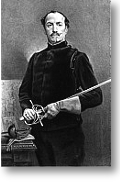
London: H. Grevel & Co., New York: B. Westermann & Co., 1892. - Hutton was part of a triad of great Victorian scholars of the sword, the other two being Sir Richard Burton and Egerton Castle. As a Victorian, Hutton partakes of all the limitations of his school. He completely discounts all swordsmanship before the 16th century. He takes a progressive view of swordsmanship, which presumes evolution towards greater and greater "perfection", although he does not show this nearly as heavily as do Burton or Castle. He also is very prone to extending the techniques of his own time and school into the past, whether or not it was appropriate. However, taking these limitations into account, the following work is an adequate introduction to the techniques of swordplay of the 16th through 18th centuries--provided the student goes on beyond Hutton. (More HTML based information is available at Classical Fencing on behalf of , Maitre d'Armes)
- released October 18, 1999- Click on the animated book image to gain access to the library's presentation pages on Hutton's book (pdf file, 11.45MB)
| <== click icon to log into the library to access the manuscript
entitled Old Sword-Play |
|
|
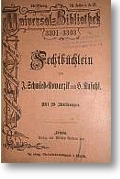
| Schmied-Kowarzik, Jolef & Kufahl, Hans, 1894, "Fechtbuchlein" - courtesy of David M. Cvet |
 |
|
Leipzig, Drud und Berlad von Bhilipp Reclam jun, 1894. - A 19th-century fencing booklet, containing 268 pages of text and illustrations depicting sabre fencing methods with illustrations extracted from Joachim Meyer's 1570 publication entitled "Gründtliche Beschreibung". The booklet also covers rapier, longsword, dussack and dagger. The booklet also covers the rules as defined by the fechtschule in the 15th century and gets into some details and history of the Marxbrüder and Federfechter organizations, with details dating back to 1487.
- released July 22, 2003
| <== click icon to log into the library to access the manuscript
entitled Fechtbuchlein |
|
|
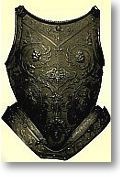
| John Starkie Gardner, 1898, "Foreign Armour in England" - Internet Archives Canadian Libraries |
 |
|
Seelley and Co. Limited. London. 1898 - A digitized publication sourced from the Robarts Library, University of Toronto, depicts over 40 illustrations and colour and B&W images including a colour image of a fantastic wooden shield from the 15th century, a breastplate embossed and parcel-gilt, and other artifacts sourced from Sir Noël Paton's Collection, National Gallery of London, Tower Armory of London and Windsor Castle. Artifacts include Italian gauntlets and breastplates, armets, tilting hemls and other artifacts.
- PDF file located on the AEMMA Online Library is available for download by clicking on the animated book image on the left (pdf file, 13MB).
|
|


 The AEMMA shield visible in some of the entries above indicates a resource that has restricted access to AEMMA internal only for research and study, and is not available for viewing in the public domain. This is due to the fact that permission to release the material into the public domain from the source was not granted.
 Some of the online manuscripts have an audio component indicated by the speaker icon situated next to the country flag on the library listings.


