 , 2000, "Medieval Combat: A 15th Century Manual of Swordfighting and Close-Quarter Combat"
 |
 |
|
| Greenhill Books/Lionel Leventhal ISBN:1-85367-418-4 - A complete re-publication of Talhoffer's "Fechtbuch aus dem Jahre 1467" manuscript including English translations of Talhoffer's text. Text in English and illustrations from the 1467 manuscript. The introduction provides a glimpse into the history behind Hans Talhoffer. |
|
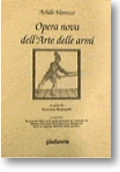
 , 1999, "Achille Marozzo, Opera Nova dell'Arte delle Armi"
 |
 |
|
| Gladiatoria, 1999, Padova, Italia - A reproduction of Achille Marozzo's "Opera Nova" treatise of 1536 with modern Italian translations and interpretations. Text in Italian along with most of the illustrations from Marozzo's treatise. |
|
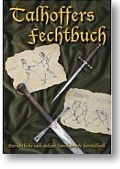
 Torsten Verhlsdonk, 1999, "Talhoffers Fechtbuch: Gerichtliche und andere Zweikämpfe darstellend" Torsten Verhlsdonk, 1999, "Talhoffers Fechtbuch: Gerichtliche und andere Zweikämpfe darstellend" |
 |
|
| VS-BOOKS; Herne ISBN:3-932077-03-2 - A complete re-publication of Talhoffer's "Fechtbuch aus dem Jahre 1467" manuscript. Text in German and illustrations from the 1467 manuscript. The book includes an introduction that describes some of the history behind the collection that includes this treatise. |
|
 Dr. Sydney Anglo, 1991, "Le Jeu de la Hache" - Archaeologia - (Society of Antiquaries of London) Dr. Sydney Anglo, 1991, "Le Jeu de la Hache" - Archaeologia - (Society of Antiquaries of London) |
 |
 |
Archaeologia, Vol. 109 (1991) Volume CIX - It is generally believed, that combat with axes had never been popular in England and, even in the reign of that enthusiast for chivalric exercise, Henry VIII, only one such encounter is recorded. According to Dr. Anglo, there exists only one known treatise devoted exclusively to the technique of axe combat - Le Jeu de la Hache (Bibliotheque Nationale, Manuscrit francais 1996), a fifteenth-century treatise on the technique of chivalric axe combat and that is now published for the first time in this article. This article begins with general remarks on the possible source and author of the original text and makes numerous references to other treatises which denote axe-play or combat with pole-weapons, including Talhoffer and Fiori de' Liberi. The next section of the article includes a complete English translation of the original French text, followed by the entire French text, and an extensive bibliography.
- restricted access to AEMMA internally only
(April 28, 1999)- Click on the AEMMA arms to gain access to this restricted material (AEMMA students only)
|
|
|
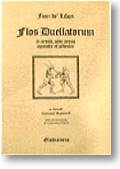
, 1998, "Flos Duellatorum in armis, sine armis, equester et pedester" |
 |
|
| Gladiatoria, 1998, Padova, Italia - A modern Italian reproduction and Italian translation of Fiore dei Liberi's "Flos Duellatorum" treatise of 1410. Text in Italian along with most of the illustrations from the Pisani-Dossi version of Liberi's treatise. |
|
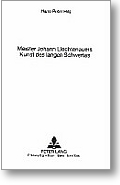
| Dr. Hans-Peter Hils, 1985, "Meister Johann Liechtenauers Kunst des langen Schwertes" |
 |
|
Peter Lang, Frankfurt am Main, 1985, ISBN 3-8204-8129-X - The complete dissertation on Dr. Hans-Peter Hils examination of the influence of Johann Liechtenauer on historical fencing. One of the most important contemporary studies of the subject, submitted to the University of Freiburg and published in 1985. This 370 page book contains detailed information on the geneology of the German fechtbuch, the influence of Liechtenauer on later works and provides examples of illustrations from various fechtbuchs for comparison and study.
- released September 30, 2001
 | <== click icon to log into the library to access the manuscript by
Dr. Hans-Peter Hils |
|
|
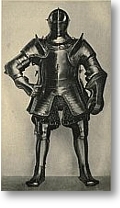
| Sir Guy Francis Laking, BART., CB. MVO. FSA., 1920, "A Record of European Armour... Vol I" - Internet Arch. Can. Lib. |
 |
 |
London. G. Bell and Sons, LTD. 1920 - A digitized publication entitled "A Record of European Armour and Arms Through Seven Centuries", is the first of five volumes sourced from the Robarts Library, University of Toronto, depicts 329 illustrations and B&W images of a variety of arms (spears, swords) and armour artifacts in the form of armoured harnesses, sourced from numerous locations including the Wallace Collection, Royal Armory in Madrid, National Bavarian Museum in Munich, British Museum and the National Germanic Museum in Nuremburg.
- PDF file is available for download by clicking on the animated book image on the left. The file size is approximately 24MB.
|
|
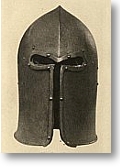
| Sir Guy Francis Laking, BART., CB. MVO. FSA., 1920, "A Record of European Armour... Vol II" - Internet Arch. Can. Lib. |
 |
|
London. G. Bell and Sons, LTD. 1920 - A digitized publication, the second of five volumes sourced from the Robarts Library, University of Toronto, depicts almost 400 illustrations and B&W images of a variety of arms and armour artifacts, sourced from numerous locations including the Wallace Collection, Royal Armory in Madrid, National Bavarian Museum in Munich, British Museum and the National Germanic Museum in Nuremburg.
- PDF file is available for download by clicking on the animated book image on the left. The file size is approximately 24MB.
|
|
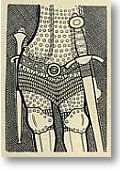
| Sir Guy Francis Laking, BART., CB. MVO. FSA., 1920, "A Record of European Armour... Vol III" - Internet Arch. Can. Lib. |
 |
|
London. G. Bell and Sons, LTD. 1920 - A digitized publication, the third of five volumes sourced from the Robarts Library, University of Toronto, depicts almost 350 illustrations and B&W images of a variety of arms and armour artifacts, with a focus on daggers, war hammers and parts of armoured harnesses sourced from numerous locations including the Wallace Collection, Royal Armory in Madrid, National Bavarian Museum in Munich, British Museum and the National Germanic Museum in Nuremburg.
- PDF file is available for download by clicking on the animated book image on the left. The file size is approximately 25MB.
|
|
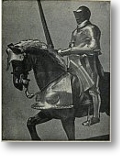
| Sir Guy Francis Laking, BART., CB. MVO. FSA., 1920, "A Record of European Armour... Vol IV" - Internet Arch. Can. Lib. |
 |
|
London. G. Bell and Sons, LTD. 1920 - A digitized publication, the fourth of five volumes sourced from the Robarts Library, University of Toronto, depicts over 400 illustrations and B&W images of a variety of arms and armour artifacts, with attention to armour made for England, decadent armour or "pisan", morions, cabassets, Italian, German and French pageant shields and hafted weapons sourced from numerous locations including the Wallace Collection, Royal Armory in Madrid, National Bavarian Museum in Munich, British Museum and the National Germanic Museum in Nuremburg.
- PDF file is available for download by clicking on the animated book image on the left. The file size is approximately 25MB.
|
|
| Sir Guy Francis Laking, BART., CB. MVO. FSA., 1920, "A Record of European Armour... Vol V" - Internet Arch. Can. Lib. |
 |
|
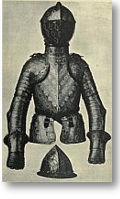
London. G. Bell and Sons, LTD. 1920 - A digitized publication, the fifth of five volumes sourced from the Robarts Library, University of Toronto, depicts over 150 illustrations and B&W images of a arms and armour artifacts from the 17th century, including harness, daggers and rapiers sourced from numerous locations including the Wallace Collection, Royal Armory in Madrid, National Bavarian Museum in Munich, British Museum and the National Germanic Museum in Nuremburg.
- PDF file is available for download by clicking on the animated book image on the left. The file size is approximately 26MB.
|
|
| Wien: F. Tempsky & Leipzig: G. Freytag, 1910, "Albrecht Dürers Fechtbüch von Friedrich Dörnhöffer" - MSUL |
 |
|
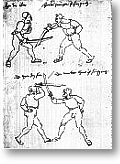
| NC251.D8 A67 1910 - A historical collection of recognizable fechtbuchs (Codex Wallerstein) which formed part of the emporer's collection (the emporer's collection as indicated with the text on the first plate: "jahrbuch der kunsthistorischen sammlungen des allerhochsten kaiserhauses, band xxvii, heft 6". Portions of the original fechtbüch (Codex Wallerstein) had its sequences re-structured, updated and transposed the original Bavarian dialect to German by Friedrich Dörnhöffer's in this re-issue in 1910.
Note: The Digital Sources Center of the University of Michigan makes documents from the Special Collections division of the library available online. Their availability in different forms (JPG, GIF, PDF, HTML, SGML, & XML) varies by collection. We believe that all of the works in this digital collection are in the public domain, and therefore have no copyright protection.
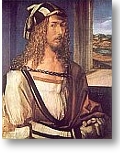
Albrecht Dürer, Self-Portrait, 1498. Oil on panel; 20 1/2 x 16 in. Museo del Prado, Madrid. Dürer was born in Nuremberg, Germany, to a family of goldsmiths. He was trained as a metalworker and painter, and in his twenties traveled in Italy. Young German artists traditionally spent a 'Wanderjahr', or a year of travel, visiting different parts of Europe and studying art. From 1512, as court painter to the Holy Roman emperor, Dürer became the most important figure in the transition from late Gothic to Renaissance style in northern Europe.
| <== click icon to log into the library to access the publication by
Tempsky and Leipzig |
|
|
| Albert F. Calvert (editor), 1907, "Spanish Arms and Armour..." - Internet Archives American Libraries |
 |
|
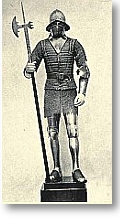
John Lane. The Bodley Head. London. 1907 - A digitized publication entitled "Spanish Arms and Armour - being a historical and descriptive account of the Royal Armoury of Madrid", with 386 illustrations depicting a variety of arms and armour artifacts such as the war sword of Ferdinand the Catholic, Spanish Man-at-arms from the 15th century, mace-bearer, foot armour, Mühlberg armour of Charles V. Other artifacts include daggers, pistols, Turkish Cannon Tinder, Persian sabres, shields used by crossbowmen, battle-axe and others.
- PDF file is available for download by clicking on the animated book image on the left. The file size is approximately 30MB.
|
|


 The AEMMA shield visible in some of the entries above indicates a resource that has restricted access to AEMMA internal only for research and study, and is not available for viewing in the public domain. This is due to the fact that permission to release the material into the public domain from the source was not granted.
 Some of the online manuscripts have an audio component indicated by the speaker icon situated next to the country flag on the library listings.
