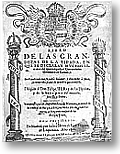
 Luis Pacheco de Narvaez, 1600, " Libro de las Grandezas de la Espada..." - Bayerischen Staatsbibliothek München Luis Pacheco de Narvaez, 1600, " Libro de las Grandezas de la Espada..." - Bayerischen Staatsbibliothek München |
 |
 |
Madrid, 1600 - Don Luis Pacheco de Narváez (Baeza, 1570–1640) was a Spanish writer on fencing. He was don Jerónimo Sánchez de Carranza's student and later published a multitude of works based on the Destreza school of fencing. Some of his works were compendiums of Carranza's work while others were less derivative.
- released November 12, 2010- Click on the BSB logo to view an online presentation of the manuscript on the Münchener Digitalisierungszentrum website.
|
|
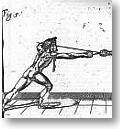
 Nicolas Giganti Venetien, 1606, "Eschole ou Theatre!" - PDF file (11.5MB) courtesy of William Wilson Nicolas Giganti Venetien, 1606, "Eschole ou Theatre!" - PDF file (11.5MB) courtesy of William Wilson |
 |
 |
NA - Nicolas Giganti's manuscript is written in both German and Italian, the German portion entitled simply as "Fechtschul:", includes 38 plates that show two combatants engaged in combat. Of these plates eight of them represent guard postures, either single sword, or sword and dagger. Thirteen plates depict thrusts of various types to the head. The remaining seventeen plates all depict various blows to the body.
- released January 15, 2003 |
|
| Torquato d'Alessandri, c1609, " Il Cavalier Compito : Dialogo" - Bayerischen Staatsbibliothek München |
 |
|
VD16 G 3915, Münchener Digitalisierungszentrum - Cavalier Compito, Nel quale si discorre d'ogni scienza, di ragion di Stato, di Medicina, di Metheora, di dubbi Caualiereschi, e del modo nouo d'imparar à schermir con spada bianca, e difendersi senz'armi, 1609 is comprised of 124 folios, no illustrations, is organized as a dialogue or conversation between a number of individuals who are introduced in the beginning of the manuscript. The subject includes discussion of the principles of fighting covering a variety of fighting styles.
- released July 19, 2009- Click on the BSB logo to view an online presentation of the manuscript on the Münchener Digitalisierungszentrum website.
|
|
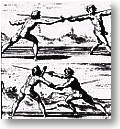
| Ridolfo Capo Ferro da Cagli, 1610, "Gran Simulacro dell'arte e dell'uso della Scherma" |
 |

 |
Printed by Salvestro Marchetti and Camillo Turi in Siena - "The Grand Simulacrum of the Art and Use of Fencing" is comprised of 137 plates of text and beautifully composed illustrations (43 plates) depicting rapier, rapier & dagger, rapier & cloak, and unusual illustrations of rapier and buckler. Published in 1610 during the height of the use of the rapier and although the works of Cavalcabo, Fabris and Giganti were also published around this time, Gran Simularcro Dell'arte e Dell'uso Della Scherma became the most highly regarded text of the time. Click the AHF logo to view more information on the joint AHF and SSI Capo Ferro Translation Project.
- released January 21, 2000 |
|
 Jakob Sutor von Baden, 1612, "Neu Künstliches Fechtbuch" - K.U.Leuven, Universiteitsbibliotheek Jakob Sutor von Baden, 1612, "Neu Künstliches Fechtbuch" - K.U.Leuven, Universiteitsbibliotheek |
 |
 |
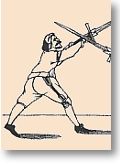
Leland Stanford University, A33439 - Sutor's "Neu Künstliches Fechtbuch" was originally written in Frankfurt in 1612 and then republished by Wilhelm Hoffman in Stuttgart in 1849. He begins his work with 16 pages covering the "langen schwerdt" or long sword. These include the classic guards and a few pages devoted to grappling techniques. He follows this with coverage of the "Dusaken" or dusack. It is essentially, a large, elongated "meat cleaver", one sharp edge, slightly curved blade with an integral hand grip. It has a certain resemblance to a large machete. His works concludes with ample coverage of the rapier, rapier and dagger trailing with a few pages covering pole-weapons.
- released October 14, 1999- Click the CD icon to view the contents of the Corble Collection CD 1999, ISBN 90 6186 948 X
 | <== click icon to log into the library to access the manuscript by
Jakob Sutor |
|
|
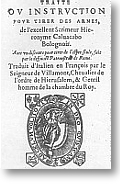
 Hieronyme Calvacabo, 1617, "Traité ou instruction pour tirer des armes" - Bibliothéque Nationale France Hieronyme Calvacabo, 1617, "Traité ou instruction pour tirer des armes" - Bibliothéque Nationale France |
 |
|
Bibliothéque Nationale France R-25935 - Manuel d'un maitre Bolognais, traduit par le Seigneur de Villamont. Traite d'une épée de taille et d'estoc seule ou avec une cape ou un poignard. "A Treatise or Instructions for the Deployment of Weapons". A handbook of a Maitre Bolognais, translated by the Lord of Villamont. A manuscript comprised of two parts or books, the first by Calvacabo which discusses the use of a cut and thrust sword alone or with a cape or dagger, the second part by the Patenostrier of Rome which discusses the epee only. There are in existence, two previous editions of this treatise printed in 1609 (R-25504) and 1610 (V-22944), by the same printer.
- released August 14, 2001
| <== click icon to log into the library to access the manuscript by
Hieronyme Calvacabo |
|
|
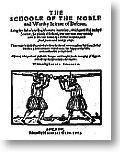
 Joseph Swetnam, 1617, "The Schoole of the Noble and Worthy Science of Defence" - PDF file (8.4MB) Joseph Swetnam, 1617, "The Schoole of the Noble and Worthy Science of Defence" - PDF file (8.4MB) |
 |
|
London. Printed by Nicholas Orre. 1617 - Little is known of this fencing master and what has been gleaned out may be seen as placing this master in a reasonably good light. One very important assignment in Swetnam's career was being the instructor of Henry of England (brother of Charles I) and it is the author's opinion that he was most likely a member of the Masters of Defense of London. In Swetnam's book, which was dedicated to Charles I, he reminded Charles of "your late brother deceased, to whom I was a tutor in the skill of weapons." A bold statement of this sort would probably not be fiction due to the ease of checking out the facts. The book was prepared as a tool to use in the instruction of the Royal pupil and unfortunately was published five years after Henry's death.
- released March 11, 2010
|
|
| Salvatore Fabris, 1624, "Della vera pratica & scienza d'armi libri..." - PDF file (23.3MB) courtesy of William Wilson |
 |
|
NA - The entire manuscript entitled "Della vera pratica & scienza d'armi libri due nel primo de quali si tratta di fondament della spada sola" focuses on the art of dagger and rapier play. It is also the first book with copper-engravings to be printed in Denmark. "Fabris divides his work into two books and six parts. The first book treats throughly the question of broad principles and of the more 'academic' actions with the rapier alone, or accompanied with dagger or cloak; it discusses in a very exhaustive manner the relative value of the past and present methods. The second book is one wherein is demonstrated certain rules with which it will be possible to strike the enemy from the moment the sword is drawn, without halting or waiting any time, principles which has never been treated by any master or writer" (Thimm p. 97).
- released October 28, 2004- Click on the Tattershal School of Defence to view and download Fabris pdf file
|
|
| Francesco Alfieri, 1653, "L'Arte di ben Maneggiare La Spada" - K.U.Leuven, Universiteitsbibliotheek |
 |

|
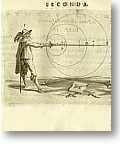
K.U.Leuven, Universiteitsbibliotheek, 4A 28 (only part 2 on CD-rom) - Alfieri's manuscript, written in 1653, describes the basic guards as it pertains to the two-handed sword (from the illustrations, they appear at least 2m long). The manuscript includes textual description of the guards, along with detailed coverage of rapier, rapier & dagger, rapier & cloak.
- released November 22, 2000- Click on the School of the Sword logo to view Alfieri's 1640 publication online.
- Click the CD icon to view the contents of the Corble Collection CD 1999, ISBN 90 6186 948 X
|
|
| Charles Besnard, 1653, "Le maistre d'arme libéral" - Bibliothéque Nationale France |
 |
|
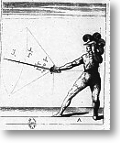
Bibliothéque Nationale France RES-V-1403 - Traittant de la théorie de l'art & l'exercice de l'espée seule ou fleuret, & de tout ce qui s'y peut faire & pratiquer de plus subtil, avec les principales figures & psotures et taille douce. "A Liberal Master at Arms" "A treatise on the theory of the art and training of espee or foil from all aspects to achieve a more subtle mode of fighting including the use of illustrations and postures."
- released August 14, 2001
| <== click icon to log into the library to access the manuscript by
Charles Besnard |
|
|
| Johann Georg Paschen [Pascha], 1659, "Vollstandiges Ring-Buch" - courtesy of Dr. Eli Steenput |
 |
|
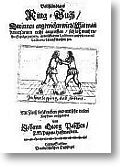
Hall in Sachsen: Melchior Oelschlegel - A 17th century book focused entirely on unarmed fighting techniques comprised of 3 parts beginning with an explaination of the concepts of the strong, half-strong and weak as they relate to the parts of the human body. The first part continues with a focus on the upper body, specifically arms with respect to strikes and counters. This is followed by the "other part" which the grapples now include the mid-section followed by the third part which looks at the lower target.
- released January 30, 2002
| <== click icon to log into the library to access the manuscript by
Johann Georg Paschen |
|
|
 Nicolaes Petter, 1674, "Klare Onderrichtinge der Voortreffelijcke Worstel-Konst" - courtesy of Dr. Eli Steenput Nicolaes Petter, 1674, "Klare Onderrichtinge der Voortreffelijcke Worstel-Konst" - courtesy of Dr. Eli Steenput |
 |
 |
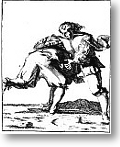
Amsterdam: Johannes Janssonius van Waesberge - Prof. Sydney Anglo's book entitled "The Martial Arts of Renaissance Europe", p. 190 states Petter's book as "historically speaking, the most important treatise on unarmed combat ever printed... the finest of all wrestling books and deservedly the most famous". It was first published in 1674 and reprinted several times, including one complete plagiarism. The combination of Petter's lucid descriptions, devoid of all jargon, and de Hooge's masterful depiction of pain and violence in the engravings, elevates the book to its position of solitary eminence. It is also probably unique in presenting an effective and complete unarmed combat system in a format from which it would be actually possible to learn.
- released February 3, 2002- Click on the icon Escrime Ancienne for another online presentation of Nicolaes Petter.
| <== click icon to log into the library to access the manuscript by
Nicolaes Petter |
|
|
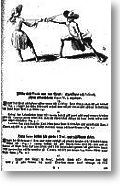
 Diederich Porath, 1693, "Palæstra svecana..." - PDF file (30 MB) courtesy of Nordic Museum (Nordiska Museet) Diederich Porath, 1693, "Palæstra svecana..." - PDF file (30 MB) courtesy of Nordic Museum (Nordiska Museet) |
 |
 |
Stockholm:1693 - The manuscript entitled "Palæstra svecana : eller Den adelige fächtare-konsten ..." written in Swedish by Diederich Porath, comes from a long line of fencing masters. Historically, the Porath family in Sweden has had strong ties with the Swedish military, with a number of family members who were officers. Diederich's brothers were also Academy fencing masters at different universities with Kristofer the fencing master of the University of Lund, Sweden, and Äbo, a fencing master in Finland, and possibly one brother in Riga, Latvia. Diederich's three sons were also fencing masters, one in Lund, one in Äbo and later Uppsala, and the last one in Uppsala. Finally, a grandson, Karl Kristofer von Porat was the fencing master of Uppsala University between 1795-1812.
The manuscript is comprised of 120 pages of text, with 19 black & white illustrations depicting two combantants wearing period garments and great hats, fencing with the epée.
- released March 28, 2009- Click on the Nordiska Museet icon to view and download Palæstra svecana pdf file
|
|
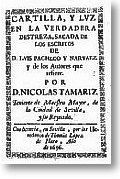
| D. Nicolas Tamariz, 1696, "Cartilla y luz en la verdadera destreza..." - PDF file (10.1MB) courtesy of William Wilson |
 |
|
Saville:1696 - The manuscript entitled "Cartilla y luz en la verdadera destreza, nacida de los escritos de Don Luis Pacheco de Narvaez" a discusses Spanish destreza or rapier of offensive techniques which are similar to Cinco Teros. The manuscript was written by Don Nicolas Tamariz, a Spanish swordsman and an official of the City of Seville, in the year 1696.
- released October 28, 2004 |
|


 The AEMMA shield visible in some of the entries above indicates a resource that has restricted access to AEMMA internal only for research and study, and is not available for viewing in the public domain. This is due to the fact that permission to release the material into the public domain from the source was not granted.
 Some of the online manuscripts have an audio component indicated by the speaker icon situated next to the country flag on the library listings.


