 Anonymous, c1500, "Goliath" - Biblioteka Jagiellonski Anonymous, c1500, "Goliath" - Biblioteka Jagiellonski |
 |
 |
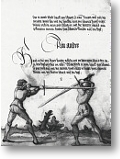
Biblioteka Jagiellonski, Krakow - Ms. Germ. Quart. 2020, NR: 5879 1989 ROK - "Goliath" is an obscure fechtbüch recently "uncovered" and resurrected by Grzegorz Zabinski (originally in association with the Brotherhood of the Eagle's Nest, Poland - no longer active) from the archives of the Biblioteka Jagiellonski, Poland, originally part of the collection of "Die Preussische Koenigliche Staatsbibliothek" in Berlin, is dated sometime early in the 16th century, written in German. Composed of 568 pages containing images that are extraordinary, many depicting fully armoured individuals engaged using longsword, spear, pollaxe weapons and other illustrations of unarmoured techniques and knife techniques.
- released November 24, 2000- Click on the "griffen" arms to view English translations of the Goliath fechtbüch.
 | <== click icon to log into the library to access the manuscript
entitled Goliath |
|
|
 Marx Walther, c1506, "Turnierbuch und Familienchronik" - UB München Marx Walther, c1506, "Turnierbuch und Familienchronik" - UB München |
 |
 |
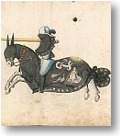
BSB-Hss Cgm 1930, Münchener Digitalisierungszentrum - Turnierbuch und Familienchronik, c1506, which may have been published in Augsberg, is comprised of 49 folios, illustrated with beautifully coloured images of armoured combatants on horseback, the horses fitted with caparisons depicting the colours of the combatant. The illustrations save for one or two have no text included, however, the last 5 1/2 folios have much text, sectioned which may be text describing each of the jousts illustrated in the preceding pages, probably with the names of the knights competing in the jousts. The 3rd last page depicts a tree of arms, which clearly indicates the jousts as being elimination bouts.
- released Sep 5, 2009- Click on the BSB logo to view an online presentation of the manuscript on the Münchener Digitalisierungszentrum website.
|
|
| Anonymous, c1508, "Fecht und Ringerbüch" - Glasgow Museums |
 |
|
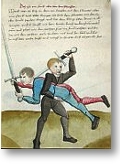
Anonymous. 1508. Germany. Manuscript E.1939.65.341. Glasgow Museums, Scotland - The fechtbüch resident at the Glasgow Museums, is comprised of written text and images numbering 184 plates. There are two sections with illustrations, the first section focused on longsword partially illustrated in colour, whereby each individual illustrated is depicted wearing a different garment and colours. The quality of the illustrations in this section appears less anatomically accurate as compared to the second section of illustrations focused on grappling. The illustrations depicting grappling/wrestling techniques only employ shades of yellow and red and may have been illustrated by a completely different artist from the first section, where the individuals depicted are more anatomically accurate.
- released August 30, 2009
| <== click icon to log into the library to access the manuscript
entitled Fecht und Ringerbüch |
|
|
| Anonymous, c1509, "Das ist ain hybsh ring byechlin" - UB München |
 |
|
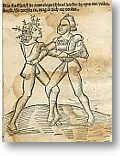
VD16 D 178BSB-Ink R-190, Münchener Digitalisierungszentrum - Das ist ain hybsh ring byechlin, c1509 is comprised of 22 folios, illustrated with figures depicting various wrestling techniques, each illustration accompanied with a couplet of German text probably describing the particular technique depicts. Interestingly, the manuscript may have fallen into a youngster's hands, as some illustrations have been "augmented" with child like drawings, such as the gentlemen depicted wearing funny hats.
- released Sep 5, 2009- Click on the BSB logo to view an online presentation of the manuscript on the Münchener Digitalisierungszentrum website.
|
|
| Anonymous, c1510, "Kunst des Ringen" - UB München |
 |
|
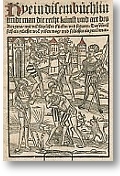
4 Inc.s.a. 1142, Münchener Digitalisierungszentrum - Anonymous, 1510 is comprised of 12 colour beautifully illustrated folia (24 pages) which describes various techniques of ringen or "wrestling". Every individual in the manuscript is unique, where some are illustrated with plants or leaves protruding from their long hair. Others wear fantastical hats as part of their wardrobe. The background is generally clear which is ideal in highlighting the important points being conveyed in each illustration, however, there are notable variations in the substrate with a single stone, multiple stones and one to three tufts of grass or floral plants. However, the illustrations do depict credible wrestling holds, complete with arm bars and keys. The style of figures and their wardrobe are reminiscent of the manuscript entitled "Goliath".
- released July 19, 2009- Click on the BSB logo to view an online presentation of the manuscript on the Münchener Digitalisierungszentrum website.
|
|
| Vegetius Renatus, Flavius / Peter / Schwarzenberg, Melchior, c1512, "De re militari" - UB München |
 |
|
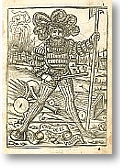
VD16 ZV 9905, Münchener Digitalisierungszentrum - De re militari, c1512 is comprised of 201 folios, illustrated with fantasical weapons of war, including illustrations depicting men in armour fighting with dagger and a small, buckler like shield fitted with a spike as long as the dagger itself. Another illustration depicts a warrior wearing something similar to the frog helm used in tournaments, wielding the same spiked buckler, and a mace in the other hand, all under water! Other illustrations depict 8 cannonts on a wheel, spinning horizontally, seemingly like a large machine gun of repeated firing in all directions, and what may be the first underwater breathing apparatus envisioned, and what appears to be the first air mattres, obviously pumped up by an attached bellows. Interestingly, there is no text in this manuscript, having the appearance of an illustrated catalogue of weapons of war.
- released July 19, 2009- Click on the BSB logo to view an online presentation of the manuscript on the Münchener Digitalisierungszentrum website.
|
|
| Jörg Wilhalm, 1522, "Fechtbuch" - Universität Augsburg |
 |

 |
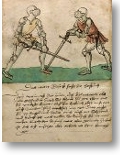
Cod. I.6.2.3, Universität Augsburg - Fechtbuch, 1522, is comprised of 92 folios with coloured illustrations and accompanying German text describing armoured combat, with the first portion covering ground fighting armoured combat depicting many illustrations where the combatants are employing "half-sword", followed by some depicting armoured dagger. The last portion of the manuscript depicts mounted armoured combat with single-hand sword and mounted armoured combat grappling. Records indicate that Jörg Wilhalm was an early 16th century German fencing master, hatmaker, and citizen of Augsburg.
- released Sep 7, 2009- Click on the Universität Augsburg logo to view an online presentation of the manuscript their digital media website.
- Click on the animated book image to view/download a PDF version of Wilhalm's manuscript (approx. 28.2MB)
|
|
| Anonymous, 1522, "Fechtbuch" - Universität Augsburg |
 |
|
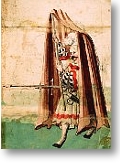
Cod. I.6.4.5, Universität Augsburg - Fechtbuch, 1522, is comprised of 102 folios with coloured illustrations and some accompanying German text describing armoured combat, with the first portion covering ground fighting armoured combat depicting many illustrations where the combatants are employing "half-sword" and grappling. The last portion of the manuscript depicts mounted armoured combat with single-hand sword and mounted armoured combat grappling and jousts.
- released Sep 8, 2009- Click on the Universität Augsburg logo to view an online presentation of the manuscript their digital media website.
|
|
| Ludwig von Eyb, 1525, "Turnierbuch" - UB München |
 |
|
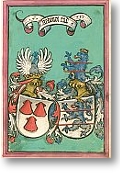
BSB-Hss Cgm 961, Münchener Digitalisierungszentrum - Turnierbuch, 1525, is comprised of 277 folios, of text and illustrated with beautifully vibrant coloured images of armoured combatants on horseback, the horses fitted with caparisons depicting the colours of the combatant. Other illustrations depict a fully armoured melée, with the armour seemingly painted with a metalic paint, however, the crests worn on the helms are in full colour. The text pages may describe who participated in the melée and their outcome.
- released Sep 5, 2009- Click on the BSB logo to view an online presentation of the manuscript on the Münchener Digitalisierungszentrum website.
|
|
| Hans Lecküchner, c1531, "Der Altenn Fechter anfengliche Kunst" - Bayerischen Staatsbibliothek München |
 |
|
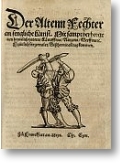
VD16 L 876, Münchener Digitalisierungszentrum - Der Altenn Fechter anfengliche Kunst, 1531 is comprised of 94 folios, including two folios of a detailed index, 40 illustrations, beginning with 5 on the longsword, 6 on messer, 7 on dagger, 20 on wrestling and closing the manuscript, two on quarterstaff. Johannes Lecküchner (ca. 1430s–1482) was a 15th century priest and fencer of the area of Nuremberg. Lecküchner's system is based on the teachings of Liechtenauer dating to about a century earlier, since Lecküchner organized his system in the same way as Liechtenauer, and also uses the same terminology that is present in Liechtenauer's longsword teachings.
- released July 19, 2009- Click on the BSB logo to view an online presentation of the manuscript on the Münchener Digitalisierungszentrum website.
|
|
 Antonio Manciolino, 1531, "Se opera nova, doue li sono tutti li documenti..." - Bibliothéque Nationale France Antonio Manciolino, 1531, "Se opera nova, doue li sono tutti li documenti..." - Bibliothéque Nationale France |
 |
|
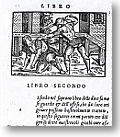
Bibliothéque Nationale France R-24858 - Antonio Manciolino, Bolognais, a écrit ce manuel qui traite, á la manière de Marozzo, de toutes les armes de son époque. "New methods and all of them documented..." A fencing book written by Antonio Manciolino of Bolognais writes in the manner of Marozzo and covers all of the contemporary weapons of the period. Other copies of this treatise can be located at Biblioteca nazionale centrale di Roma, Biblioteca universitaria di Padova or Biblioteca reale di Torino.
- released August 15, 2001
| <== click icon to log into the library to access the manuscript
entitled Se opera nova... |
|
|
| Achille Marozzo, 1536, "Opera Nova" - K.U.Leuven, Universiteitsbibliotheek |
 |

 |
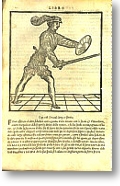
K.U.Leuven, Universiteitsbibliotheek, 4A 938 - Opera Nova by the Bolognese master discusses single combat (offensive & defensive) with numerous weapons accompanied with 82 figures (woodcuts) depicted with & without arms of all maneuvres & guards. The fighters depicted are shown with swords, staff weapons or daggers which are described with intelligent text in a systematic manner. An interesting note is that most illustrations are signed with a monogram .b. which has been conjectured to be Francesco Barattini or Giovanni Britto though no absolute evidence supports this notion. Marozzo's treatise is comprised of 18 plates and was republished in 1568 as "Arte Dell' Armi".
- released November 22, 2000 |
|
| Hans Czynner, 1538, "Über die Fechtkunst und den Ringkampf" - Graz, Universitätsbibliothek |
 |
 |
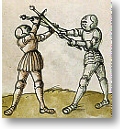
Graz, Universitätsbibliothek - Ms.963 - The Hans Czynner manuscript which is indirectly influenced by the earlier work of Liechtenauer with respect to longsword techniques, is comprised of 170 illustrated pages that includes illustrations of armoured longsword techniques. In addition, the ringen or grappling style in keeping with the tradition of Meister Ott's emphasis on ringen is evident in the illustrations in Czynner's manuscript with respect to close-quarters combat. The most notable attributes are the emphasis on the attack to the leg in terms of lifts and throws - a clear indication of Meister Ott's ringen influence.
- restricted access to AEMMA internally only (March 14, 2002) |
|
| Fabien von Auerswald, 1539, "Ringer kunst : fünff und achtzig stücke" - Graz, Universitätsbibliothek |
 |
 |
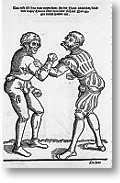
NA - A beautifully illustrated manuscript focused entirely on "The Art of Wrestling" which includes 80 plates describing a rather systemized approach to executing wrestling techniques.
- released November 2, 2001- Click on the "escrime ancienne" to view an online presentation of Fabien von Auerswald
|
|
| Anonymous, c1539, "Fechtbuch" - Universität Augsburg |
 |
|
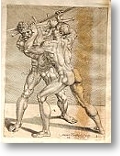
Cod. I.6.2.5, Universität Augsburg - Fechtbuch, c1539, is comprised of 106 folios with ink-drawn illustrations. It is dated to 1539, and appears to have been written by a student (or at least a great admirer) of maister Hans Medel of Salzburg. The writer himself is anonymous. The fechtbuch is a pretty unique take on the "standard" Liechtenauer art of fencing. The author writes that this is the glossa of "Sigmund Schining" (most likely the same as Sigmund Ringeck), but that it has been "improved" and "expanded" by other masters, most notably by Hans Medel. The author also mentions Hans Seydenfaden in two places in the manuscript. Seydenfaden is known from the list of the "Liechtenauer gesellschaft" in Paulus Kal, who also mentions that Seydenfaden was from Erfurt. Of Hans Medel nothing is (so far) known outside of Cod. I.6.2.5. (Andreas Engström, GHFS).
- released Sep 7, 2009- Click on the Universität Augsburg logo to view an online presentation of the manuscript their digital media website.
- Click on the animated book image to view/download a PDF version of Wilhalm's manuscript (approx. 37.4MB)
|
|
| Hans Burgkmair, 1540, "Turnierbuch - Kopie nach dem Original von Hans Burgkmair d.Ä" - UB München |
 |
|
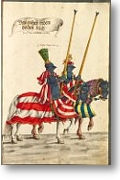
BSB-Hss Cod.icon. 403, Münchener Digitalisierungszentrum - Turnierbuch - Kopie nach dem Original von Hans Burgkmair d.Ä, c16th, which may have been published in Augsberg, is comprised of 51 folios, illustrated with beautifully coloured images of armoured combatants on horseback, the horses fitted with caparisons depicting the colours of the combatant. The tournament book begins with the introductions of tournament contestants, beginning with Titelseite, Gestecharten und Rennen des Turniers zu Pferd, followed by a beautifully illustrated Wolfgang von Polheim, depicting a standard, and luxurious garments, followed by the tournament knights "Turnierreiter", an unusual illustration of a rider holding up a blank sign by the name of Anton von Yfan.
- released Sep 6, 2009- Click on the BSB logo to view an online presentation of the manuscript on the Münchener Digitalisierungszentrum website.
|
|
| Paulus Hector Mair, 1510-1550, "Opus amplissimum de arte athletica..." - UB München |
 |
|
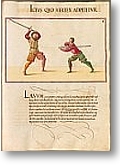
BSB-Hss Cod.icon. 393(1), Münchener Digitalisierungszentrum - A relatively unknown manuscript located at the Münchener Digitalisierungszentrum, Munich, dated sometime in the 15th century, written in both German and Latin. Images are extraordinary, many depicting unarmoured individuals engaged using longsword, dagger, quarter-staff, dussack, pollaxe and what appears to be a sickle.
- released January 29, 2001
| <== click icon to log into the library to access the manuscript
entitled Opus amplissimum... |
|
|
| Paulus Hector Mair, 1510-1550, "Secunda Gladiatoriae Artis Sive..." - UB München |
 |
|
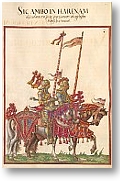
| BSB-Hss Cod.icon. 393(2), Münchener Digitalisierungszentrum - A second volume of an incredable manuscript located at the Münchener Digitalisierungszentrum, Munich, dated sometime in the 15th century. Images are extraordinary, many depicting unarmoured individuals engaged using longsword, dagger, quarter-staff, dussack, pollaxe and what appears to be a sickle. Interestingly, this particular volume looks into trial by combat or at the minimum, duels, which include sword & buckler on foot against a rider on horseback wielding a sword. Other plates depict incredibly detailed views of the jousting lists, and a pair of combatants in the centre of the lists wielding hewing shields.
Other plates depict fully armoured jousting, in one case depicts an exploding shield after being struck by the lance. Other plates depict an unarmoured combatant wielding a lance on foot, against an armoured rider wielding a lance, and another plate depicting an unarmoured combatant wielding a sword against an armoured combatant on horseback wielding a sword.
- released December 7, 2009 |
|
 Gašper Lamberger, 1544, "Der römischen khay(serlichen) unnd kü(niglichen)..." - Kunsthistorisches Museum Wien Gašper Lamberger, 1544, "Der römischen khay(serlichen) unnd kü(niglichen)..." - Kunsthistorisches Museum Wien |
 |
|
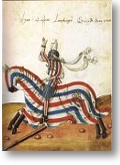
| Codex A 2290 Kunsthistorisches Museum Wien, Hofjagd-und Rüstkammer - A pictorial tournament book commissioned by Gašper Lamberger or "Casper Lamberger", a notable Slovenian (Carniolian) noble, and his feats of arms at tournaments during the late 15th century and which depicts other Slovenian nobles including Frederick II of Celje. The tournaments took place in southern Germany. The original manuscript was the focus of study of the only Slovenian book published on the subject of medieval tournaments by Dušan Kos, published in 1997, Viharnik (Ljubljana).
The original manuscript actually depicts a number of tournaments, which are a selection of Lamberger's "best" or most notable encounters in the period between 1485 to approx. 1500. The codex is comprised of two parts, the first being the tournament accounts, the second, an ad hoc geneaology and visitor's book where individuals who were shown in the tournament book wrote some notes or impressions.
- released December 23, 2009 |
|
 Roger Ascham, 1545, "The Schole of Shootinge" - Bodleian Library, Oxford Roger Ascham, 1545, "The Schole of Shootinge" - Bodleian Library, Oxford |
 |
|
Bodleian Library, Oxford - In 1545, London, Ascham published the treatise Toxophilus or the Schole or Partitions of Shooting partly in defense of archery against those who found the sport unbefitting a scholar. The work was dedicated to Henry VIII who enjoyed the treatise so much that he granted Ascham a pension: ten pounds a year. Ascham was further honored by being assigned to tutor Prince Edward.
- released July 24, 2003
| <== click icon to log into the library to access the manuscript
entitled The Schole of Shootinge |
|
|
| Paulus Hector Mair, 1550, "Geschlechterbuch der Stadt Augsburg" - UB München |
 |
|
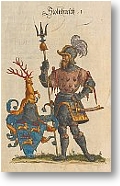
| BSB-Hss Cod.icon. 312 b, Münchener Digitalisierungszentrum - Although not a fighting treatise, this beautifully illustrated and coloured manuscript depicts over a 100 armoured gentlemen, in various styles of harness and each wielding a variety of weapons along with a shield which supposedly depicts their personal coat of arms. The beautiful illustrations and the fact that this is also Paulus Mair's work, warrants inclusion in this online library.
The harnesses depicted are illustrated with great detail down to the links on the mail worn by individuals. Their helmets are beautifully appointed with crests of feathers or gold and weapons are often depicted with tassles handing from the weapon's head or queue.
- released December 7, 2009 |
|
| Camillo Agrippa, 1553/1604, "Trattato di Scienza d'Arme" - PDF file (12.4MB) courtesy of William Wilson |
 |
 |
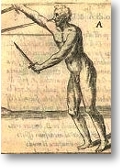
NA - Camillo Agrippa was a theorist who simplified Marozzo's eleven guards to four. He was regarded as the man who defined rapier as a thrusting weapon as well as one to be used for cutting. He published his book "Trattato di Scienza d'Arme" (Treatise on the Science of Arms) in 1568.
- released December 14, 1998
| <== click icon to log into the library to access the manuscript
entitled Trattato di Scienza d'Arme |
|
|
Jörg Wilhalm, 1556, "Maister Lichtenauer's Fechtbüch" - Bayerische Staatsbibliothek
|
 |
|
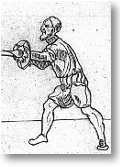
Bayerische Staatsbibliothek, BSB Cgm 3712 - Records indicate that Jörg Wilhalm was an early 16th century German fencing master, hatmaker, and citizen of Augsburg. It is reported that there are five fechtbuchs attributed to Wilhalm, the earliest published in 1522 (see further up this library page) with Cgm 3712 being the last of Wilham's publications. There are 429 plates, which includes numerous illustrations in the last portion of the manuscript, depicting sword & buckler and armoured combat. The illustrator for the armoured combat was not as professional as the illustrator of the sword & buckler section of the treatise.
- released September 22, 2008 |
|
Hans Lebkommer, 1558, "Fechtbüch - die Ritterliche / Manniche Kunst..." - UB München
|
 |
|
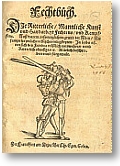
K.U.Leuven, Universiteitsbibliotheek, 4A 514 (CD ROM) and UB München- Fechtbüch of c. 1482. W4 Art.234 (microfiche) - Hans Lebkommer's fechtbüch was a woodcut published in Frankfurt in 1558 by Christian Egenolph. The fechtbüch contains 48 pages of beautifully illustrated techniques that include the great sword, backsword/messer, dagger, unarmed techniques and quarter-staff. The manuscript is available on the CD in digitized form.
- released November 22, 2000- Click the CD icon to view the contents of the Corble Collection CD 1999, ISBN 90 6186 948 X
- Click on the "griffin" to view English translation of Lebkommer
| <== click icon to log into the library to access the manuscript
entitled Fechtbüch - die Ritterliche... |
|
|
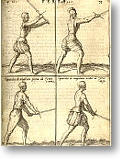
| Achille Marozzo, 1568, "Arte Dell' Armi" - PDF file (33.8MB) courtesy of William Wilson |
 |
|
K.U.Leuven, Universiteitsbibliotheek, 4A 940 - The first republication of Marozzo's "Opera Nova" (published in 1536, see above) of over 200 pages which covers several weapons disciplines including the use of the shield, pole-arms as well as many illustrations that depict unarmed defense against the knife, and some illustrations on knife-on-knife combat.
- released January 21, 2000 |
|
| Jeronimo de Caranza, 1569, "De la filosofia de las armas..." - PDF file (65 MB) courtesy of William Wilson |
 |
|
Biblioteca Nacional Madrid, ES - Caranza was recognized as one of the best known masters of the famous Distreza, the Spanish method of rapier combat. Caranza was recognized as the founder of the Spanish School and wrote of it in his De La Filosofia de las Armes (1583). Narvaez quantified many of Caranza's teachings and philosophies regarding the Destreza in his Libro de las Grandezas de la Espada in 1600. For more information pertaining to the Spanish School, Maestro Ramón Martínez wrote an article entitled "The Demystification of the Spanish School" (On-line Article, in 3 parts, 2000).
- released January 1, 2003 |
|
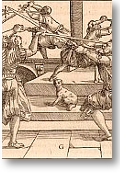
| Joachim Meyer, 1570, "Gründtliche Beschreibung des Fechtens" - Straßburg, 1570 [VD16 M 5087] |
 |

|
Straßburg, 1570 [VD16 M 5087] - Meyer's treatise roughly translated: "A Thorough Description of the Free, Knightly and Noble Art of Fencing, Showing Various Customary Defenses, Affected and Put Forth with Many Handsome and Useful Drawings" was first published in Strasbourg in 1570, by Joachim Meyer and illustrated by Tobias Stimmer with woodcuts depicting fighters wielding pollaxes, rapiers, two-handed swords, dusaks along with unarmed fighting. The Die Freifechter has a letter-for-letter transcript of the original German of the rapier chapter of Meyer's treatise and Escrime Ancienne for illustrations from Meyer's treatise that covers longsword, dusack, dagger and staff.
- released January 2, 2001- Click on the griffen shield to view an English translation in progress of Meyer's fechtbüch
- Click on the Higgins Armoury logo for an analysis of Meyer's fechtbüch.
- Click on the BSB logo to view an online presentation of the manuscript on the Münchener Digitalisierungszentrum website.
|
|
| Giovanni dall'Agocchie, 1572, "Dell'Arte di Scrimia" - PDF file (44.MB) |
 |
|
NA- Interestingly, the manuscript is structured in the form of a dialogue between Messer Lepido (a student or collegue of Messer Giovanni?) and Messer Giovanni dall'Agocchie, discussing the Bolognese tradition originating in the Dardi school. The manner of writing is very clear and includes a significant amount of detail on the theory of swordsmanship along with detailed discussions on the fundamentals of swordsmanship. The impetus of the manuscript is the desire to convey the most simplest techniques to handle most situations, as Lepido asks what parts of fencing should a person concentrate on when a student has little time to learn.
- released November 9, 2009 |
|
 Henri de Saint-Didier, 1573, "Traicté contenant les secrets du premier livre..." - Bibliothéque Nationale France Henri de Saint-Didier, 1573, "Traicté contenant les secrets du premier livre..." - Bibliothéque Nationale France |
 |
|
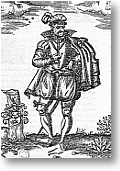
Bibliothéque Nationale France RES-V-1402 - Premier traité d'escrime écrit par un Français, ce livre traite de l'utilisation de l'épée de taille et d'estoc. A la fin, un court traité de l'auteur sur le jeu de la paume, l'ancêtre de notre moderne tennis, et ses liens avec l'escrime. "Treatise containing the secrets of the first book on éspée only, mother of all the weapons..." Probably the first fencing treatise written by the French, this book discusses the use of the cut and thrust sword. Towards the end of the treatise, the author writes about exercises called the "play of the palm", a predecesor of modern tennis and who describes its relationship with fencing. The style of Henri de Sainct Didier's illustrations appear as adaptations of di Grassi, however his illustrations differ by the inclusion of geometric ground plans and numbered footprints to indicate correct sequence of movements. A unique quality are the labels assigned to the figures, 'Le Lieutenant' on the left and 'Le Prevost' on the right.
- released August 10, 2001
| <== click icon to log into the library to access the manuscript by
Henri de Saint-Didier |
|
|
| Henrici a Gunterrodt, c1579, "De Veris Principiis Artis Dimicatoriae..." - Bayerischen Staatsbibliothek München |
 |
|
VD16 G 3915, Münchener Digitalisierungszentrum - De Veris Principiis Artis Dimicatoriae, tractatus brevis : ad illustrissimum principem Ioannem, ducem Megapolensem, 1579 is comprised of 43 folios, no illustrations, the prologue written in Latin, whereas, the rest of the manuscript is written in what may be a dialect of Italian, appears to be a dissertation on the comparative analysis of martial arts, beginning with a review of the Greek athletism, continuiing with a comparative analysis of the guards with different weapons, and even mentions the dussack within the manuscript.
- released July 19, 2009- Click on the BSB logo to view an online presentation of the manuscript on the Münchener Digitalisierungszentrum website.
|
|
| Christoff Rösener, 1589, "Ehren Tittel vnd Lobspruch Der Ritterlichen..." - Bayerischen Staatsbibliothek München |
 |
|
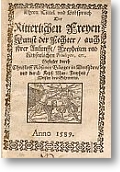
VD16 R 2830, Münchener Digitalisierungszentrum - Ehren Tittel vnd Lobspruch Der Ritterlichen Freyen Kunst der Fechter, auch jhrer Ankunfft, Freyheiten vnd Keyserlichen Priuilegien etc., 1589 is comprised of 52 folios, including 16 illustrations including a coat of arms, a walled city, an unarmoured longsword bout, a figure of Constantia, a portrait of Marxbrüder or a member of Marxbrüder, a battle scene, an unusual illustration of a man seated at a table writing with a griffin in the foreground, two horsemen, one on left with trumpet, and lions fighting.
- released July 19, 2009- Click on the BSB logo to view an online presentation of the manuscript on the Münchener Digitalisierungszentrum website.
|
|
| Giacomo di Grassi, 1594, "His True Arte of Defense" - PDF file (12.8MB) courtesy of William Wilson |
 |
|
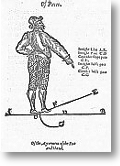
K.U.Leuven, Universiteitsbibliotheek, 4A 642 - The document covers two-handed sword, poll-arm, and pike, as well as rapier, and rapier with dagger, cloak , buckler, and target. First written in Italian in 1570, later translated into English and published in 1594.
- released November 9, 1998- Click on the Tattershall logo to view the Giacomo di Grassi pdf file (12 MB)
- Click the CD icon to view the contents of the Corble Collection CD 1999, ISBN 90 6186 948 X
| <== click icon to log into the library to access the manuscript by
Giacomo di Grassi |
|
|
| Vincentio Saviolo, "His Practise In Two Bookes" - London, Printed by John Wolff, 1595 |
 |
|
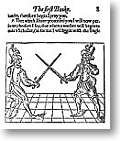
London, Printed by John Wolff, 1595 - The treatise entitled "Vincentio Saviola His Practise In Two Bookes. The first in treating of the use of the Rapier and Dagger. The second, of Honor and honorable Quarrels." A treatise recording a lively and urbane discussion of the laws of duelling, having first appeared in Italian in 1558, between Vincentio and his friend Luke, covering the rapier with dagger techniques.
- released November 9, 1998
| <== click icon to log into the library to access the manuscript by
Vincentio Saviolo |
|
|
| George Silver, 1599, "Paradoxes of Defence" - London |
 |

|
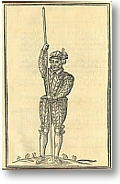
| K.U.Leuven, Universiteitsbibliotheek, 4A 1307 - George Silver spends a fair amount of time frothing at the mouth about the folly of the newfangled Italian rapier play, as opposed to the English sword. He provides some interesting discussion on the proper use of sword and buckler, two-handed sword, dagger, various pole-arms, and pike. Probably his most valuable contribution is his dissertation on combative theory in terms of the true and false fights, the four grounds and four governors.
A pdf file containing a republication of George Silver's works by George Bell and Sons, London, 1898, edited with introduction by Cyril G.R. Matthey is available for download by clicking on the Adobe image on the left. (12.2MB). Courtesy of the Linacre School of Defence.
- released November 9, 1998 - Click on the Linacre School of Defence arms to view and download Silver in pdf format
- Click the CD icon to view the contents of the Corble Collection CD 1999, ISBN 90 6186 948 X
|
|
| Anonymous, undated, "Turnierbuch. Ritterspiele gehalten von Kaiser Friedrich III..." - UB München |
 |
|
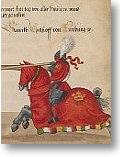
BSB Cod.icon. 398, Münchener Digitalisierungszentrum - Turnierbuch. Ritterspiele gehalten von Kaiser Friedrich III. und Kaiser Maximilian I. in den Jahren 1489 - 1511, c16th, which may have been published in Augsberg, is comprised of 90 folios, illustrated with beautifully coloured images of armoured combatants on horseback, the horses fitted with caparisons depicting the colours of the combatant. The tournament book is sectioned into specific tournaments, beginning with Kaiser Freidrich III and Sohn König Maximillian at Linz, 1489-1490, followed by illustrations depicting the tournament at Innsbruck, 1497, Innsbruck, 1498, Nürnberg, 1491 and Heidelberg 1511.
- released Sep 5, 2009- Click on the BSB logo to view an online presentation of the manuscript on the Münchener Digitalisierungszentrum website.
|
|


 The AEMMA shield visible in some of the entries above indicates a resource that has restricted access to AEMMA internal only for research and study, and is not available for viewing in the public domain. This is due to the fact that permission to release the material into the public domain from the source was not granted.
 Some of the online manuscripts have an audio component indicated by the speaker icon situated next to the country flag on the library listings.


 "click icon to log into the library")