| George Silver. Paradoxes of Defence. London. 1599 |
(5) Of Weapons and Vantages
(5.1) Of the Length of Weapons
Of the Length of the Sword *19*
Of the length of weapons, and how every man may fit himself to the perfect
length of his weapon, according to his own stature, with brief reasons
wherefore they 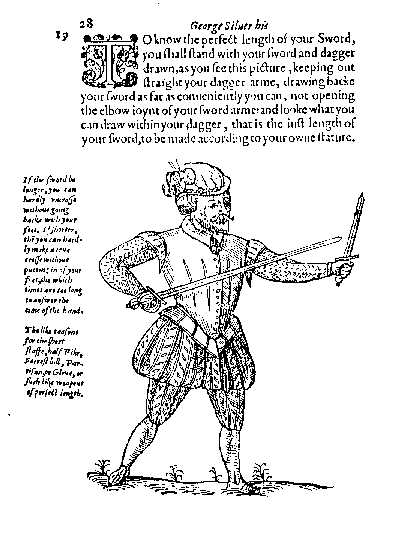 ought
to be so. To know the perfect length of your sword, you shall stand
with your sword and dagger drawn, as you see this picture, keeping out
straight your dagger arm, drawing back your sword as far as conveniently
you can, not opening the elbow joint of your sword arm, and look what you
can draw within your dagger, that is the just length of your sword, to
be made according to your own stature.(16)
ought
to be so. To know the perfect length of your sword, you shall stand
with your sword and dagger drawn, as you see this picture, keeping out
straight your dagger arm, drawing back your sword as far as conveniently
you can, not opening the elbow joint of your sword arm, and look what you
can draw within your dagger, that is the just length of your sword, to
be made according to your own stature.(16)
As I have here made a figurative demonstration, to know the perfect
length of the sword, as afore is said, so have I in the page following,
for the plainer understanding of the reader, set forth a form of standing,
to know the lengths of the short staff, half pike, forest bill, partisan,
and gleve, or such like weapons of advantage, as shall also best fit the
statures of all men. The perfect length of your two handed sword
is, the blade to be the length of the blade of your single sword.
To know the perfect length of your short
staff, or half
pike, forest bill,
partisan, or glaive,
or such like weapons of vantage and perfect lengths, you shall stand upright,
holding the staff upright close by your body, with your left hand, reaching
with your right hand your staff as high as you can, and then allow to that
length a space to set both your hands, when you come to fight, wherein
you may conveniently strike, thrust, and ward, & that is the just length
to be made according to your stature. And this note, that these lengths
will commonly fall out to be eight or nine foot long, and will fit, although
not just, the statures of all men without any 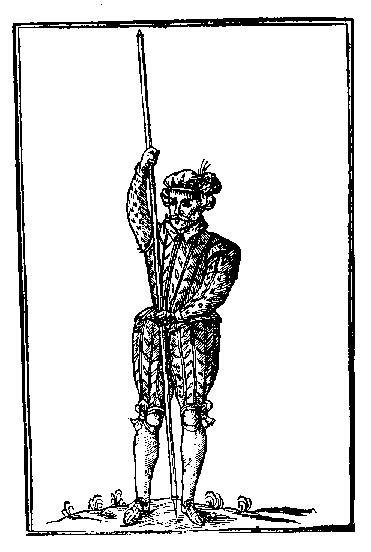 hindrance
at all unto them in their fight, because in any weapon wherein the hands
may be removed, and at liberty, to make the weapon longer of shorter in
fight at his pleasure, a foot of the staff being behind the backmost hand
does no harm. And wherefore these weapons ought to be of the lengths aforesaid,
and no shorter, these are the reasons: If they should be shorter, then
the long staff, morris pike, and such like weapons over and above the perfect
length, should have great advantage over them, because he may come boldly
and safe without any guard or ward, to the place where he may thrust home,
and at every thrust put him in danger of his life, then can the long staff,
the morris pike, or any longer weapon lie nowhere within the compass of
the true cross, to cross and uncross, whereby he may safely pass home to
the place, where he may strike or thrust him that has the long weapon,
in the head, face, or body at his pleasure.
hindrance
at all unto them in their fight, because in any weapon wherein the hands
may be removed, and at liberty, to make the weapon longer of shorter in
fight at his pleasure, a foot of the staff being behind the backmost hand
does no harm. And wherefore these weapons ought to be of the lengths aforesaid,
and no shorter, these are the reasons: If they should be shorter, then
the long staff, morris pike, and such like weapons over and above the perfect
length, should have great advantage over them, because he may come boldly
and safe without any guard or ward, to the place where he may thrust home,
and at every thrust put him in danger of his life, then can the long staff,
the morris pike, or any longer weapon lie nowhere within the compass of
the true cross, to cross and uncross, whereby he may safely pass home to
the place, where he may strike or thrust him that has the long weapon,
in the head, face, or body at his pleasure.
Of the lengths of the Battle Axe, Halberd, or Black Bill *20*
Of the lengths of the battle
axe, halberd, or black
bill, or such like weapons of weight, appertaining unto guard or battle.
In any of these weapons there needs no just length, but commonly they
are, or ought to be five or six foot long, & may not well be used much
longer, because of their weights, and being weapons for the wars and battle,
when men are joined close together, may thrust, & strike sound blows,
with great force both strong and quick. And finally for the just lengths
of all other shorter or longer weapons to be governed with both hands,
there is none. Neither is their any certain lengths in any manner of weapons
to be used with one hand, over or under the just length of the single sword.
Thus ends the length of weapons.
(5.2) Of the Vantages of Weapons in their Kinds, Places, & Times *21*
Of the vantages of weapons in their kinds, places, & times, both in
private and public fight. First I will begin with the worst weapon, an
imperfect and insufficient weapon, and not worth the speaking of, but now
being highly esteemed, therefore not to be unremembered. That is, the single
rapier, and rapier and poniard.
- The single sword has the vantage against the single rapier.
- The sword and dagger has the vantage against the rapier and poniard.
- The sword & target has the advantage against the sword and dagger, or the rapier and poniard.
- The sword and buckler has advantage against the sword and target, the sword and dagger, or rapier and poniard.
- The two handed sword has the vantage against the sword and target, the sword and buckler, the sword and dagger, or rapier and poniard.
- The battle axe, the halberd, the black-bill, or such like weapons of weight, appertaining unto guard or battle, are all one in fight, and have advantage against the two handed sword, the sword and buckler, the sword and target, the sword and dagger, or the rapier and poniard.
- The short staff or half pike, forest bill, partisan, or glaive, or such like weapons of perfect length, have the advantage against the battle axe, the halberd, the black bill, the two handed sword, the sword and target, and are too hard for two swords and daggers, or two rapier and poniards with gauntlets, and for the long staff and morris pike.
- The long staff, morris pike, or javelin, or such like weapons above the perfect length, have advantage against all manner of weapons, the short staff, the Welch hook, partisan, or glaive, or such like weapons of vantage excepted, yet are too weak for two swords and daggers or two sword and bucklers, or two rapiers and poniards with gauntlets, because they are too long to thrust, strike, and turn speedily. And by reason of the large distance, one of the sword and dagger-men will get behind him.
- The Welch hook or forest bill, has advantage against all manner of weapons whatsoever. Yet understand, that in battles, and where variety of weapons are, among multitudes of men and horses, the sword and target, the two handed sword, battle axe, the black bill, and halberd, are better weapons, and more dangerous in their offense and forces, than is the sword and buckler, short staff, long staff, or forest bill. The sword and target leads upon shot, and in troops defends thrusts and blows given by battle axe, halberds, black bill, or two handed swords, far better than can the sword and buckler.
- The morris pike defends the battle from both horse and man, much better than can the short staff, long staff, or forest bill.
Again the battle axe, the halberd, the black bill, the two handed sword, and sword & target, among armed men and troops, by reason of their weights, shortness, and great force, do much more offend the enemy, & are then much better weapons, than is the short staff, the long staff, or the forest bill.
(5.2.1) Of the Insufficiency and Disadvantages of the Rapiers *22*
Of the insufficiency and disadvantages of the rapiers-fight in battle.
For the single rapier, or rapier & poniard, they are imperfect &
insufficient weapons: and especially in service of the prince, when men
shall join together, what service can soldier do with a rapier, a childish
toy wherewith a man can do nothing but thrust, nor that neither, by reason
of the length, and in every moving when blows are a dealing, for lack of
a hilt is in danger to have his hand or arm cut off, or his head cloven.
And for wards and grips, they have none, neither can any of these fine
rapier men, for lack of use, tell how to strike a sound blow.
(5.2.2) Of the Vantages and Sufficiency of the Short Sword *23 *
Of the vantages and sufficiency of the short sword fight in battle.
The short sword, and sword and dagger, are perfect good weapons, and especially
in service of the prince. What a brave weapon is a short sharp light sword,
to carry, to draw, to be nimble withal, to strike, to cut, to thrust both
strong and quick. And what a good defence is a strong single hilt, when
men are clustering and hurling together, especially where variety of weapons
are, in their motions to defend the hand, head, face, and bodies, from
blows, that shall be given sometimes with swords, sometimes with two handed
swords, battle axes, halberds, or black bills, and sometimes men shall
be so near together, they shall have no space, scarce to use the blades
of their swords below their waist, then their hilts (their hands being
aloft) defend from the blows their hands, arms, heads, faces and bodies.
Then they lay on, having the use of blows and grips, by force of their
arms with their hilts, strong blows, at the head, face, arms, bodies, and
shoulders, and many times hurling together, scope is given to turn down
their points, with violent thrusts at the faces and bodies, by reason of
the shortness of their blades, to the mighty annoyance, discomfort, and
great destruction of their enemies. One valiant man with a sword in his
hand, will do better service, than ten Italians, or Italianated with their
rapiers.
(5.2.3) The Sword and Buckler has the Vantage against the Sword and Dagger *24*
That all manner of double weapons, or weapons to be used with both hands,
have advantage against the single rapier or single sword, there is no question
to be made.
That the sword and buckler has the vantage against the sword and dagger.
The dagger is an imperfect ward, although borne out straight, to make the
space narrow, whereby a little moving of the hand, may be sufficient to
save both sides of the head, or to break the thrust from the face or body,
yet for lack of the circumference his hand will lie too high or low, or
too weak, to defend both blow and thrust. If he lies straight with a narrow
space, which is to break the thrust, then he lies too weak, and too low
to defend his head from a strong blow. If he lies high, that is strong
to defend his head, but then his space will be too wide to break the thrust
from his body. The dagger serves well at length to put by a thrust, and
at the half sword to cross the sword blade, to drive out the agent, and
put him in danger of his life, and safely in any of these two actions defend
himself. But the buckler, by
reason of his circumference and weight, being well carried, defends safely
in all times and places, whether it be at the point, half sword, the head,
body, and face, from all manner of blows and thrusts whatsoever, yet I
have heard many hold opinion, that the sword and dagger has the advantage
of the sword and buckler, at the close, by reason of the length and point
of the dagger, and at the point of the sword, they can better see to ward
than with a buckler. But I never knew any, that won the close with the
dagger upon the sword and buckler,
but did with himself out again: for distance being broken, judgement fails,
for lack of time to judge, and the eye is deceived by the swift motion
of the hand, and for lack of true space with the dagger hand, which cannot
be otherwise, for lack of circumference to defend both blow and thrust,
it is impossible for lack of true space in just time, the agent having
gotten the true place, to defend one thrust or blow of a hundred. And it
is most certain, whosoever closes with sword and dagger against the sword
and buckler, is in great danger
to be slain. Likewise at the point within distance, if he stand to defend
both blow and thrust with his dagger, for lack of true space and distance,
if he has the best eye of any man, and could see perfectly, which way the
thrust or blow comes, and when it comes, as it is not to deny that he may,
yet his space being too large, it helps him nothing, because one man's
hand being as swift as another man's hand, both being within distance,
he that strikes or thrusts, hurts the warder. The reason is this: the agent
being in the first motion although in his offense, further to go than the
warder to defend, yet the warder's space being too large, the blow or thrust
will be performed home, before the warder can come to the true place to
defend himself, and although the warder does perfectly see the blow or
thrust coming, so shall he see his own ward so far from the true place
of his defence, that although he does at that instant time, plainly see
the blow or thrust coming, it shall be impossible for him to recover the
true place of his ward, 'til he his wounded. But let the warder with his
dagger say, that it is not true which I have said, for the eyes to behold
the blow or thrust coming, so has he as good time to defend himself. Herein
he shall find himself deceived to, this is the reason: the hand is the
swiftest motion, the foot is the slowest, without distance the hand is
tied to the motion of the feet, whereby the time of the hand is made as
slow as the foot, because whereby we redeem every time lost upon his coming
in by the slow motion of the foot & have time thereby to judge, when
& how he can perform any action whatsoever, and so have we the time
of the hand to the time of the feet.
Now is the hand in his own course more swift than the foot or eye, therefore
within distance the eye is deceived, & judgement is lost, and that
is another cause that the warder with the dagger, although he has perfect
eyes, is still within distance deceived(17).
For proof that the hand is swifter than the eye & therefore deceives
the eyes: let two stand within distance, & let one of them stand still
to defend himself, & let the other flourish & false with his hand,
and he shall continually with the swift motions of his hand, deceive the
eyes of him that stands watching to defend himself, & shall continually
strike him in diverse places with his hand. Again, take this for an example,
that the eyes by swift motions are deceived: turn a turn-wheel swift, &
you shall not be able to discern with your best eyes how many spokes are
on the wheel, no nor whether there are any spokes at all, or whereof the
wheel is made, and yet you see when the wheel stands still there is a large
distance between every spoke. He that will not believe that the swift motion
of the hand in fight will deceive the eye, shall stare abroad with his
eyes, & feel himself soundly hurt, before he shall perfectly see how
to defend himself. So those that trust to their fight, the excellency of
a good eye, their great cunning, & perfect wards of the daggers, that
they can see better to ward than with a buckler, shall ever be deceived.
And when they are wounded, they say the gent was a little too quick for
them. Sometimes they say they bear their dagger a little too low. Sometimes
they are thrust under the dagger, then they say, they bear it a little
too high. Sometimes a thrust being strongly made, they being soundly paid
therewith, say, they were a little too slow, & sometimes they be soundly
paid with a thrust,& they think they were a little too quick. So they
that practice or think to be cunning in the dagger ward, are all the days
of their lives learning, and are never taught(18).
(5.2.4) The Sword and Buckler has the Vantage against the Sword and Target *25*
That the sword and buckler
has the vantage against the sword and target. The sword & target together
has but two fights, that is the variable fight, & the close fight,
for the close fight, the number of his feet are too many to take against
any man of skill having the sword & buckler,
& for the variable fight although not so many in number, yet too many
to win the place with his foot and strike home. The sword & buckler
man out of his variable, open & guardant fight can come bravely off
& on, false & double, strike & thrust home, & make a true
cross upon every occasion at his pleasure. If the sword & target man
will fly to his guardant fight, the breadth of the target will not suffer
it, if to his open fight, then has the sword & buckler man in effect
the sword and buckler to the single, for in that fight by reason of the
breadth, the target can do little good or none at all.
(5.2.5) The Short Staff *26*
Now for the vantage of the short staff against the sword and buckler, sword
& target, two handed sword, single sword, sword and dagger, or rapier
and poniard, there is no great question to be in any of these weapons.
Whensoever any blow or thrust shall be strongly made with the staff, they
are ever in false place, in the carriage of the wards, for if at any of
these six weapons he carries his ward high & strong for his head, as
of necessity he must carry it very high, otherwise it will be too weak
to defend a blow being strongly made at the head, then will his space be
too wide, in due time to break the thrust from his body. Again, if he carries
his ward lower, thereby to be in equal space for readiness to break both
blow & thrust, then in that place his ward is too low, and too weak
to defend the blow of the staff: for the blow being strongly made at the
head upon that ward, will beat down the ward and his head together, and
put him in great danger of his life. And here is to be noted, that if he
fights well, the staff man strikes but at the head, and thrusts presently
under at the body. And if a blow is first made, a thrust follows, and if
a thrust is first made, a blow follows, and in doing of any of them, the
one breeds the other. So that however any of these six weapons shall carry
his ward strongly to defend the first, he shall be too far in space to
defend the second, whether it be blow or thrust.
Yet again for the short staff: the short staff has the vantage against
the battle axe, black bill, or halberd: the short staff has the advantage,
by reason of the nimbleness and length: he will strike and thrust freely,
and in better and swifter time than can the battle axe, black bill, or
halberd, and by reason of his judgement, distance and time, fight safe.
And this resolve upon, the short staff is the best weapon against all manner
of weapons, the forest bill excepted.
Also the short
staff has advantage against two swords and daggers, or two rapiers,
poniards and gauntlets(19),
the reasons and causes before are for the most part set down already, the
which being well considered, you shall plainly see, that whensoever any
one of the sword & dagger men, or rapier and poniard men shall break
his distance, or suffer the staff man to break his, that man which did
first break his distance, or suffer the distance to be one against him,
is presently in danger of death. And this cannot in reason be denied, because
the distance appertaining to the staff man, either to keep or break, stands
upon the moving of one large space always at the most, both for his offense
or safety. The other two in the breach of their distance to offend the
staff man, have always four paces at the least therein they fall too great
in number with their feet, and too short in distance to offend the staff
man. Now there rests no more to be spoken of, but how the staff man shall
behave himself to keep that distance, that one of the sword & dagger
men get not behind him, while the other shall busy him before. To do that
is very easy, by reason of the small number of his feet, as it were in
the center point of a wheel, the other two to keep their distance, are
driven to run twenty feet for one, as it were upon the uttermost part of
the circle of the wheel, all this while the staff man is very well. Then
it comes thus to pass, whether they both labor to get behind him, or one
keeps directly before him while the other gets behind him, yet before that
is brought to pass, they shall either be both before him or just against
both sides of him, at which time soever the staff man finding either within
distance, he presently in making of his play, slays, with blow or thrust
one of them, or at the least puts him in great danger of his life. If the
staff man takes his time, when they are both before him, that is to say,
before they come to the half ring, just against both sides of the staff
man, then he that is nearest within distance is slain by blow or thrust,
or put in great danger of his life. But if the sword and dagger men do
keep their distance until they come to the just half ring against the sides
of the staff man, and then break distance, that man that first breaks distance
is slain with blow or thrust, or sore hurt, and in great danger of death,
and the staff man in making that play at that instant, must turn with one
large pace, which he may easily do, before the other can get near enough
to offend him by reason that he has to make with his feet but one large
pace, but the other has to make with his feet but one large pace, but the
other has at the least three paces. But if the sword and dagger men will
in the time they are before him, keep their distance in the time of their
being upon the middle part of the outside of the circle, right against
both sides of him, & will labor with all heed & diligence to be
both or one of them behind him, that troubles the staff man nothing at
all, for in that very time, when he finds them past the middle part of
the circle, he presently turns, by the which he shall naturally set himself
as it were in a triangle, and both the sword and dagger-men, shall thereby
stand both before him in true distance of three paces, from offending of
him at the least, as at the first they did. And take this for a true ground,
there is no man able to ward a sound blow with the sword and dagger, nor
rapier, poniard and gauntlet, being strongly made at the head, with the
staff, and run in withal, the force of hands in such, being in his full
motion and course, that although the other carries his ward high and strong
with both hands, yet his feet being moving from the ground, the great force
of the blow will strike him with his ward, and all down flat to ground.
But if he stands fast with his feet, he may with both weapons together,
strongly defend his head from the blow, but then you are sufficiently instructed,
the thrust being presently made, after the blow full at the body, it is
impossible in due time to break it, by reason of the largeness of his space.
(5.2.6) Vantages of the Short Staff *27*
The short staff has the vantage against the long
staff, and Morris pike,
and the Forest Bill against
all manner of weapons. The reasons are these. The short staff has
the vantage of the long staff and Morris pike in the strength & narrowness
of space in his four wards of defence. And the Forest bill has the vantage
of all manner of weapons in his strength and narrowness of space in his
eight wards of defence. And the rather because the bill has two wards for
one against the staff or Morris pike, that is to say, four with the staff,
and four with the head, and is more offensive than is the staff or Morris
pike. Yet a question(20) may be made by
the unskillful, concerning the fight between the long staff and the short,
in this sort: Why should not the long staff have advantage against the
short staff, since that the long staff man, being at liberty with his hands,
may make his staff both long and short for his best advantage, when he
shall think it good, and therefore when he shall find himself overmatched
in the length of his staff, by the strength of the short staff, and narrowness
of space of his four wards of defence, he can presently by drawing back
of his staff in his hands, make his staff as short as the other's, and
so be ready to fight him with at his own length? To this I answer(21),
that when the long staff man is driven there to lie, the length of his
staff that will lie behind him, will hinder him to strike, thrust, ward,
or go back in due time. Neither can he turn the contrary end of his staff
to keep out the short staff man from the close, nor safely to defend himself
at his coming in.
(5.2.7) Again of the Vantages of Weapons *28*
Make this for a general rule, all long staves, Morris pikes, Forest bills,
Javelins, or such like long weapons, of what sort so ever, being above
the true lengths, the shortest has the advantage, because they can cross
and uncross in shorter time than can the longer. And all manner of short
weapons to be used with both hands, as staves, and such like, being under
the perfect lengths, the longest have the advantage, and all manner of
weapons to be used with one hand, that are above the perfect length of
the single sword, the shortest has the vantage, and all manner of weapons
under the just length of the short sword, as falchions, skaines, or hangers,
woodknives, daggers, and such like short weapons of imperfect lengths,
the longest has the advantage, because the fight of these weapons consist
within the half or quarter sword, wherein by the swift motions of their
hands, their eyes are deceived, and in those weapons, commonly for their
hands lie no defence. And if two shall fight with staves or swords, or
what weapons soever, the one of them having his weapon longer than the
perfect length, and the other shorter than the perfect length, he that
has the longer has the vantage, because the shorter can make no true cross
in true time. The short staff or half pike, Forest bill, Partisan, or glaive,
or such like weapons of perfect length, to be used with both hands, have
the advantage against two swords and daggers, or two rapiers, poniards
and gauntlets, and against all other weapons whatsoever, the Forest bill
excepted.
(5.2.8) Again for the Short Staff or Half Pike *29*
The short staff is most commonly the best weapon of all others, although
other weapons may be more offensive, and especially against many weapons
together, by reason of his nimbleness and swift motions, and is not much
inferior to the Forest bill, although the Forest bill is more offensive,
and has more wards, because the Staff is very uncertain, but the Bill is
a more certain mark, by reason of the breadth of the head, whereby as the
Bill has advantage in his wards in the head, so therefore has the staff
the like defence, or rather more, to play upon the head of the bill, not
only to make a perfect good ward, but thereby, the rather to cast the Bill
out of the right line, whereby the staff man may thrust safe, and endanger
the Bill-man: and the rather because therein he is the first mover, wherein
there is great vantage, both in time and force. And if the Bilman is not
very skillful (all vantages and disadvantages of both sides being considered,)
the short Staff will prove the better weapon. Lastly note this(22),
that long Staves, Morris pikes, and such like weapons of imperfect lengths,
being to be used with both hands, notwithstanding their imperfect lengths,
are perfect weapons to be used, the one against the other, and their fights
therein perfect, because in drawing of them back betwixt their hands, their
motion is swifter backwards, than is the time of the agents feet forwards,
by which all their lost times are redeemed. Therefore these weapons in
their fights, the one against the other are perfect. And these weapons
in the night are the best weapons of all others, and have great advantage
against the Forest bill, short staff, or any manner of short weapons whatsoever,
for these causes: they boldly make home their fights, and if need be against
desperate men, that will venture themselves to run in, they redeem their
lost times. But the other with shorter weapons for lack of light, can make
no true defence.
Thus ends the vantages of weapons.
Released: November 09, 1998 / Last modified: December 12, 2008