Fiore dei Liberi's "Flos Duellatorum"

Introduction

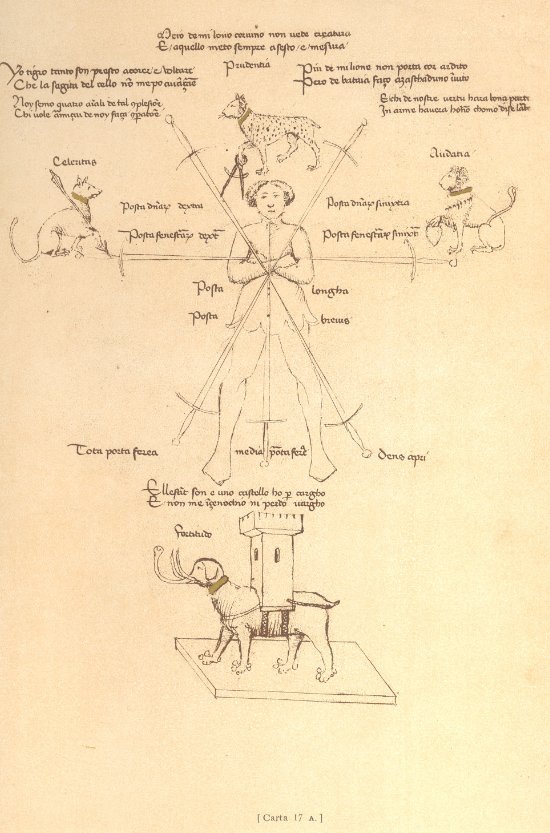
Flos Duellatorum or Flower of Battle comes in three flavours of the original treatise written or at least dictated by Fiore dei Liberi in 1410. These are known as the Novati/Pisani-Dossi (which is the source of this online presentation), the J.Paul Getty Museum or Getty's copy (MS Ludwig XV13) and The Pierpont Morgan Library or Morgan's copy. AEMMA has both the Pisani-Dossi and Getty's version, however, the Getty's version remains available only internally for study due to restrictions of copyright enforced by the Getty Museum. The Getty's version of Liberi's treatise is the most comprehensive, containing detailed textual descriptions accompanying each of the illustrations rather than sometimes the cryptic verses that accompany the illustrations in the Pisani-Dossi version.
 

The illustration on the left is an example of the illustrations found in the Getty's version. It depicts the guard of the window or posta de fenestra instabile. Note the extensive text that accompany's this illustration. It is typical of all illustrations in the Getty's version. On the other hand, the illustration on the right is the same posta from the Pisani-Dossi copy. The text that accompany's these illustrations are typically 2-4 lined verses that communicate the intent of the illustration and which are often somewhat cryptic. The text is rarely in the technical terms as those found in the Getty's version.

The study of this treatise is an ongoing project and probably will never end. Enhanced interpretations, the application of the techniques described into practice and the validation of those techniques through their employment in fighting engagements will continue to enhance our understanding of this most detailed of martial art treatises. Liberi states that the techniques described in his treatise can be deployed in unarmoured duels and in armoured combat engagements. He also indicated that due to the very dangerous and deadly techniques that it is advisable not to use this treatise to train anyone that is of questionable character or "thugs" because these people do not possess the self-discipline to control themselves in conflict situations.

Online Fiore Resources:
Click to view a colour version of the Getty's
  • The Getty has produced an online presentation of the colour version of MS. LUDWIG XV 13. The treatise is described as: Tempera colors, gold leaf, silver leaf, and ink on parchment bound between pasteboard and covered with light brown calf. Click on the image on the left to view the Getty presentation of Fiore.
Click to view the Getty's and PD's translation
  • This project is designed to bring together the work that The Exiles have been involved in since the late 1990s. The project has been essentially to bring together those works that are attributed to Fiore dei Liberi. The site has translations of both Getty's and PD versions, and is updated periodically with more of the manuscripts as they become available. Click on the "wyvern" to access the material available on the Fiore Project. Some of the available documents are listed below for your convenience.
Click to view Liberi's entire Novati version of the manuscript - 42.4MB
  • A complete digital file (pdf format - 42.4MB) of the Novati/Pisani-Dossi version is available for viewing or download, courtesy of David Peck (Chicago Swordplay Guild) and William Wilson (Tattershall School of Defence) by clicking on the Adobe icon left.
Click to view Liberi's entire Novati translation of the manuscript
 
  • Click on the shield left to view a complete online English translation of this (Novati) version of Liberi's treatise offered by the "Knights of the Wild Rose" to the WMA community. Note: The Knights of the Wild Rose website no longer exists, and therefore, their interpretation and presentation of Flos Duellatorum is no longer available. However, a "backup" copy of the same presentation has been archived on the AEMMA website for your continued exploration and study by clicking on the Knights of the Wild Rose's arms (shield) on the left.
Click to view an informative video on Fiore and his treatise
  • Click on the image on the left to view an interesting video created in Italy depicting Fiore's treatise. Some of the interpretations are bang-on, while others are different than AEMMA's interpretation. The verbiage is in English, and the video production is quite good. A choice of downloading a file 31.7MB in size, or for a higher resolution file wieghing in at 163.7MB. For more information on the video, contact the producer of the video:

 
Available Printed Fiore Resources:
  • Massimo Malipiero. Il Fior di battaglia di Fiore dei Liberi da Cividale - Il Codice Ludwig XV 13 del J. Paul Getty Museum Publisher: Ribis, Marimar s.r.l., November 2006.
    Massimo Malipiero in cooperation with the Paul Getty Museum has created this excellent resource, containing his interpretations of the text and illustrations, as well as high quality colour images of the Getty's version of Fiore dei Liberi's treatise. Massimo includes his own illustrations in attempting to explain the principles behind some of Fiore's techniques, and provides a comparison analysis between the Getty's version and the Pisani-Dossi and Morgan.
    Click on the image on left for more details
  • Marco Rubboli, Luca Cesari. Manuale di arte del combattimento del XV secolo Publisher: Il Cerchio, November 2002.
    This volume introduces a comparitive analysis between three existing manuscripts of the Flos Duellatorum: Pisani-Dossi, Getty's and Morgan's versions, with integral reproduction of the text of all the versions and numerous images up to now lacking and found in manuscripts conserved in the United States. Suit of transcription, one biography of Master Fiore and a technical appendix, the book filler moreover the study of Pisani-Dossi for the edition of 1902, completed with the information derived from the more recent studies.
    Click on the image on left for more details
  • Giovanni Rapisardi. Flos Duellatorum in armis, sine armis, equester et pedester Publisher: Gladiatoria, 1998, Padova, Italia.
    A facsimile of the treatise written by Fiori de' Liberi, in 1410, composed primarily of illustrations with short rhyming captions in Italian. Sections on wrestling, dagger, sword, spear, two handed sword, armored combat, pole-axe, and mounted combat. Considerable discussion of disarming techniques. Two-handed sword (spadone) has the greatest emphasis. (Text in Italian)
    A pdf file of the Pisani-Dossi version from La Compagnia della Spada is available by clicking here (4.8MB).
    Click on the image on left for more details

Notes on the treatise:

  • As one goes through the manuscript, one will note that some of the figures are wearing crowns and or a leg band just below the knee. The figures are divided into two groups: the masters who attacks first are wearing a "golden" crown, while their student's who react to this attack will have a "golden" band tied around the base of the knee. In the illustrations, whenever a master will engage another master, he will wear both the crown and the band under the knee.
  • The online presentation of the treatise and their sections correspond to the structure of the Pisani-Dossi version. It is similar as well to the Getty's version of the treatise.
  • It is interesting to note that Liberi refers to the opponents in training as one of master, scholar, player (zugadore) and companion (compagno). Again, further stressing the discipline and control during training, in which you are not trying to win a competition during training, but learning along with your partner, the subtleties of the techniques.
  • The citations for the three known versions of Liberi's treatise are:
    1. Fior di Battaglia: MS M.383 - The Pierpoint Morgan Library (codice "MORGAN")
    2. Fior di Battaglia: MS Ludwig XV 13 - J. Paul Getty Museum (codice "GETTY")
    3. Flos Duellatorum (Pisani-Dossi MS): F. Novati, Flos duellatorum: Il Fior di battaglia di maestro Fiore dei Liberi da Premariacco (Bergamo, 1902)

The AEMMA's training program as described in The Art of Longsword Combat - Book #1 is heavily influenced by the work of Liberi. Through the years of training and practice, it became quite evident that the methodology defined by Liberi is a viable approach to training. We apologize for any errors in our own interpretation, not claiming to be linguistics experts, however, the periodic review of the material will invoke improvements and correction based on the enhanced experience gained through working with this material in the training and fighting situations. Feel free to email AEMMA at your comments, criticisms, kudos, whatever.


The Treatise

Introduction

  1. Brief Interpretation on the Prologue on Fiore dei Liberi (Pisani-Dossi)
  2. The First Prologue (original Latin with English translation from the Pisani-Dossi)
  3. Prologue (from the Getty's version - The Exiles)

1.0 Abrazare - Grappling/Wrestling

2.0 Daga - Dagger

Note: The dagger material is sourced from the Knights of the Wild Rose (KWR) and the additional notes added were based on the study of the Getty's version of Liberi's treatise are entered as red text in the KWR pages.

3.0 Spada - Arming Sword

Note: The arming sword material is sourced from the Knights of the Wild Rose (KWR) and the additional notes added were based on the study of the Getty's version of Liberi's treatise are entered as red text in the KWR pages.

4.0 Spada Longa - Longsword

5.0 Azza - Pollaxe

Note: The pollaxe material is sourced from the Knights of the Wild Rose (KWR) and the additional notes added were based on the study of the Getty's version of Liberi's treatise are entered as red text in the KWR pages.
  • Quattro Posta
    • posta breve serpentina  (guard of the short serpent)
    • posta de vera crose  (guard of the true cross)
    • posta de donna  (guard of the woman)
    • posta di denti chingiale  (guard of the tooth of the boar)
  • Pollaxe plays

6.0 Lanza - Spear

Note: The spear material is sourced from the Knights of the Wild Rose (KWR) and the additional notes added were based on the study of the Getty's version of Liberi's treatise are entered as red text in the KWR pages.
  • Sei Magistro de Lanza Posta  (Six Masters of the Guards of the Spear)
  • "Right Guards"
    • tutta porta de ferro destra  (full iron door, right)
    • meza porta de ferro  (middle iron door)
    • nobele posta di finestra destra  (noble guard of the window, right)
  • "Reverse Guards"
    • posta di denti chingiale  (guard of the tooth of the boar)
    • posta de vera crose  (guard of the true cross)
    • posta di finestra sinistra  (guard of the window, left)

7.0 Lanza e di Spada a Cavallo - Spear & Sword on Horseback


Credits:
Many illustrations were originally sourced various "bad" photocopies of Liberi's treatises in the public domain that are floating around the "fechtbuch community" and have been introduced on this web site back in November of 1998. However, since then, many of the illustrations have been updated with images sourced from a contemporary re-publication of the Pisani-Dossi version of Fiore dei Liberi entitled "Flos Duellatorum in armis, sine armis, equester et pedester", published by Gladiatoria 1998 in Padova, Italy and authored by Giovanni Rapisardi.

The Liberi images on this site is made available to the WMA community with permission of . Translations and the webifying of the treatise by on behalf of the Academy of European Medieval Martial Arts. The translations of the historical verse into English are very approximate and AEMMA does not take any responsibility for their accuracy of Medieval Italian to modern English.

Thanks to Nina Scott-Stoddart (www.ninascottstoddart.com) for creating the audio version of the Italian text.


Released: October 20, 1999
Last modified: June 26, 2007